
The relationship between the cavity type of the cone crusher and the minimum discharge opening as well as the recommended feeding size
Over the years of manufacturing crusher parts, I have often been asked an unavoidable question – how exactly should the cavity type, the minimum discharge port and the recommended feeding size of the cone crusher be properly coordinated? Many on-site technicians, when they first take over equipment debugging or when they want to optimize production capacity by replacing parts, are often a bit confused by the relationship among these parameters. In fact, they are not isolated figures but a triangular relationship that checks and balances each other and jointly determines the crushing effect and the stability of the equipment.
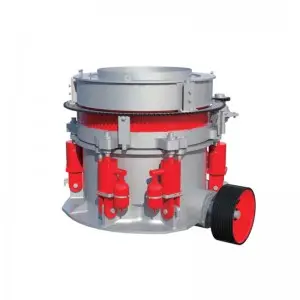
Let’s start with the cavity type. The cavity types of cone crushers are roughly divided into standard type, medium type, short head type, etc. This is not only a difference in the shape of the shell, but also directly affects the retention time of materials in the crushing cavity and the force path. The depth of the standard cavity is relatively long, providing more space for the material to undergo multiple extrusions and bends, making it suitable for continuous processing of coarse crushing or medium particle size. The short head cavity Narrows and deepens the end of the crushing zone, allowing the material to be repeatedly impacted and sheared before approaching the discharge port, which is more suitable for fine crushing and high-precision particle size control. Once the cavity type is determined, its geometric profile defines the general movement trajectory of the material within the cavity and indirectly limits the adjustment range of the discharge port and the appropriate size of the feed.
Let’s talk about the minimum discharge opening again. This is the minimum width that the discharge port of the cone crusher can be adjusted to during operation, which determines the ultimate fineness of the finished product. However, the minimum discharge opening cannot be set as many as one wants; it is closely related to the cavity type. Due to the obvious end closure of the short-head cavity, the discharge opening can be made narrower, resulting in finer products. The standard cavity is limited by the shape of the cavity. A too small discharge opening will impede the flow of materials, causing cavity blockage or accelerating the wear of the liner. On the other hand, the minimum discharge opening is also restricted by the structure of the equipment and the strength of its accessories. If one blindly pursues fineness while neglecting structural allowance, it is easy for key parts to be overloaded for a long time.
The recommended feed size is a reference upper limit given from the upstream feeding perspective and is usually proportional to the width of the discharge port. Based on experience, the maximum side length of the feed generally should not exceed a certain proportion of the width of the discharge opening (with slight differences for different cavity types). Otherwise, if large pieces enter the crushing area, the initial impact may cause a sudden increase in the force on the accessories, not only accelerating wear but also potentially disrupting the preset crushing path, leading to loss of control over the particle shape. For instance, if the discharge opening is set at 20mm, the size of the feed block is best controlled within 60mm (the specific proportion depends on the cavity type), so that the material can gradually decompose in the cavity instead of being forcefully hit on the liner or the crusher parts all at once.
The coordination among these three is actually achieving a dynamic balance. The cavity type determines “how to crush”, the minimum discharge port indicates “how fine it can be crushed”, and the recommended feeding size reminds “Don’t feed too much at one time”. When selecting models and replacing accessories, if one only focuses on adjusting one parameter, it often leads to neglecting one aspect for another – for instance, blindly increasing the feeding size in pursuit of output may cause the fine crushing cavity to wear out prematurely. Or, if the discharge opening is pressed too finely but the standard cavity is still used, the machine load will soar and the particle shape will be uneven instead.
For experienced mine production scheduling and aggregate processing engineers, understanding this relationship will provide more basis when replacing the liner plate of the cone crusher, adjusting the crushing wall or the mortar wall. Different cavity types correspond to different liner profiles, which also determine the replacement cycle of accessories and the distribution characteristics of wear resistance. If the feeding size and the discharge opening are matched reasonably, it can not only extend the service life of the crusher parts, but also make the energy consumption and maintenance cost of the entire line more stable.
In addition, the on-site working conditions will also affect the trade-offs among the three. When the raw material has high hardness and strong abrasiveness, appropriately widening the feed size and slightly increasing the discharge opening can reduce the frequency of impact on the accessories. In situations where high-specification finished products are required, there may be a preference for short head cavities and smaller discharge openings, while strictly controlling the size of the feed blocks to ensure that each crushing process is closer to the ideal trajectory. There is no absolute formula here. It is more about making fine matches based on the material characteristics, production capacity targets and the status of accessories.
Ultimately, the cavity type, the minimum discharge port and the recommended feeding size of the cone crusher form a set of interrelated system parameters. The cavity type determines the crushing path, the discharge port sets the fineness limit, and the feeding size ensures the safety and efficiency of the process. Only by understanding the intrinsic connection among them can we avoid detours in selection, commissioning and parts management, and ensure that the equipment is both effective and durable in complex working conditions.
Post time: Dec-18-2025