
Worldwide, sustainable infrastructure development has become a core priority, and asphalt pavement recycling represents a key practice supporting this global trend.
This technology not only conserves valuable raw materials but also significantly reduces waste landfilling, fully aligning with the principles of the circular economy.
However, for purchasing managers and engineers operating recycling equipment, crushing Reclaimed Asphalt Pavement (RAP) presents a unique challenge, with operating conditions vastly different from those of crushing natural rock.
At the heart of these differences lie special and demanding requirements for impact crusher blow bars.
Understanding these requirements is essential to maintaining efficient equipment performance and controlling operational costs.
Unique Challenges of RAP Crushing: Adhesion, Abrasion & Impact
Unlike hard, dry granite or limestone, reclaimed asphalt pavement is a composite material consisting of aggregate bound with asphalt binder.
During crushing, it imposes three major challenges on blow bars:
High Temperature & Adhesion
Frictional heat generated during crushing, combined with the temperature-sensitive nature of asphalt, easily softens the binder and causes it to adhere to the blow bar surface.
This buildup distorts the aerodynamic profile of the blow bar, reduces crushing efficiency, and forms a persistent layer that accelerates uneven wear.
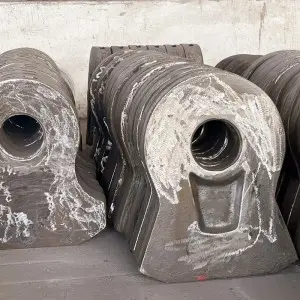
Abrasive Wear
Sand and stone aggregates within RAP remain the primary source of wear.
These hard particles continuously scour and impact the blow bar surface, leading to progressive material loss.
High-Stress Impact
Effectively reducing large pieces of asphalt pavement requires blow bars to withstand severe impact forces.
Materials must maintain sufficient toughness to avoid cracking or chipping under heavy blows.
As a result, blow bars used for asphalt recycling must achieve a delicate balance among wear resistance, toughness, and anti-adhesion performance.
Material Selection Trade‑Off: High Manganese Steel vs. High‑Chromium Iron
Against these challenges, the two dominant blow bar materials — high manganese steel and high‑chromium iron — exhibit distinctly different performance characteristics.
High Manganese Steel
High manganese steel is widely recognized for its exceptional toughness.
Under high-impact conditions, its surface undergoes work hardening, with hardness increasing sharply to deliver strong wear resistance.
Advantages: Outstanding toughness makes it ideal for crushing RAP containing unbreakable contaminants such as steel bars, effectively preventing blow bar breakage.
Disadvantages: In asphalt recycling applications with insufficient impact energy or elevated operating temperatures, work hardening may be incomplete, leading to lower-than-expected wear resistance and shortened service life.
High‑Chromium Iron
High‑chromium iron contains a dense distribution of ultra-hard chromium carbides throughout its matrix, granting it unmatched abrasive wear resistance.
Advantages: Service life far exceeds that of high manganese steel under pure abrasive conditions. Its hard surface also helps reduce asphalt adhesion.
Disadvantages: Relatively low toughness. When RAP contains high levels of metallic debris or under overloaded conditions, high‑chromium iron blow bars carry a higher risk of fracture.
Alloy Steel: Achieving the Optimal Balance
Given the inherent limitations of high manganese steel and high‑chromium iron, a more optimized solution is the use of specialized alloy steel.
By precisely adjusting the ratios of key alloying elements — including chromium (Cr), molybdenum (Mo), and nickel (Ni) — materials engineers can develop a custom-grade alloy that combines high toughness and high hardness.
Alloy steel blow bars engineered specifically for asphalt recycling are designed to meet three critical goals:
Sufficient toughness to withstand impact loads when crushing large RAP pieces and tolerate minor metallic contaminants.
Excellent wear resistance to withstand aggressive abrasion from aggregates and ensure long service life.
Improved surface properties: optimized smoothness and hardness through specialized heat treatment to minimize asphalt adhesion.
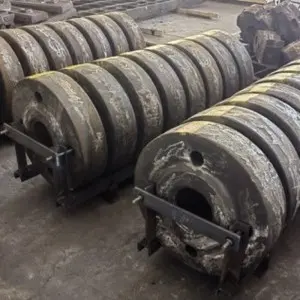
Procurement Decision Guide: Beyond Upfront Price
For procurement decision-makers, selecting the right blow bar should not be based solely on initial purchase cost.
Evaluating Total Cost of Ownership (TCO) is the far more strategic approach.
Analyze your feed material: Identify the source, size, asphalt content, and level of metallic contamination in your RAP.
Clarify performance priorities: Based on your actual conditions, determine whether wear resistance or impact toughness is more critical.
Communicate in depth with suppliers: Provide detailed operating parameters and ask about the chemical composition and heat treatment process of recommended materials. A professional supplier will deliver application-specific material guidance, not one-size-fits-all products.
Calculate long-term costs: Factor in service life, replacement frequency, downtime expenses, and wear-part cost per ton of material processed to identify truly cost-effective solutions.
Conclusion
Asphalt pavement recycling is a green technology that delivers broad economic and environmental benefits, yet its efficient operation depends on deep understanding of core wear components.
Crushing RAP imposes unique demands on blow bars, requiring balanced performance in wear resistance, impact resistance, and anti-adhesion.
By scientifically assessing operating conditions and making informed choices among high manganese steel, high‑chromium iron, and specialized alloy steel, operators can significantly improve equipment utilization, lower operational costs, and advance more reliably along the path of sustainable development.
Post time: Jun-26-2026