
Avoiding Pitfalls: The Hidden Issues Behind “Low-Cost” Equipment—High Energy Consumption and Short Lifespan
Last week, Mr. Zhang, who runs a stone quarry in Southeast Asia, vented his frustrations over the phone: “Old Li, this is ridiculous! Last year, I went for the bargain and bought a batch of jaw plates 20% below market price. What happened? Output didn’t increase, the electricity bills skyrocketed, the machines started shaking violently, and now the bearings are making noise!” This call didn’t surprise me at all. In the crusher parts industry, the term “low price” often functions like a cleverly designed bait. It directly appeals to buyers’ instinct to control costs, yet it often skillfully conceals the real killers: shockingly high energy consumption, absurdly short service life, and the resulting high hidden costs and safety risks.
If your procurement list faces price pressures, or if the concept of “Total Cost of Ownership (TCO)” remains unclear to you, this article is written for you. We won’t discuss abstract theories. Instead, using real-world cases and data witnessed firsthand in mines and quarries, we’ll break down the invisible costs behind “low-cost” parts, item by item. Understanding these costs will help you avoid profit-eroding pitfalls and make truly cost-effective procurement decisions.
Pitfall 1: The Electricity Bill Assassin—How Low-Cost Parts Stealthily Increase Your Energy Consumption
Many buyers focus solely on the unit price of parts, forgetting that machinery requires electricity to operate. For a crusher, the largest ongoing cost is actually electricity.
To cut costs, low-cost parts often compromise on materials and manufacturing processes. For example, a substandard jaw plate might use unoptimized tooth profiles and low-grade steel. This creates two problems: First, inefficient crushing requires the equipment to run longer and at higher power to achieve rated output. Second, poor stress distribution increases wasted energy, converting significant electricity into heat and vibration rather than effective crushing force.
Industry Case Study: A large iron ore mine in Inner Mongolia conducted comparative tests on two batches of cone crusher bowl liners at different price points. Batch A (low-cost) was 15% cheaper than Batch B (standard price). However, after installing Batch A, the same crusher processing ore of identical hardness saw an 8% increase in electricity consumption per ton. Calculations showed that the additional electricity costs over three months of operation exceeded the savings from the initial purchase price difference. Not to mention the increased carbon footprint—a potential cost in today’s increasingly stringent environmental regulations.
Common Question: “How can I determine if parts will cause high energy consumption before purchasing?”
Answer: Request key data from suppliers: the part’s weight, material reports (especially yield strength and toughness indicators), and an explanation of the design principles. An excellent design—such as a streamlined crushing chamber and optimized rake angle—can significantly improve energy efficiency. Additionally, compare energy consumption per unit output provided by previous users of the same model.
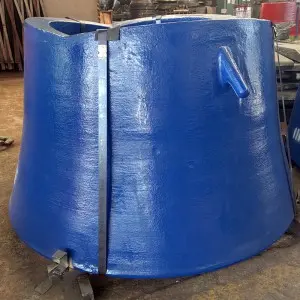
Pitfall #2: Shrinking Lifespan—The Hidden Cost of Frequent Replacement Far Exceeds Your Expectations
“Cheap is cheap, but you replace them often.” This is the most common feedback. Short accessory lifespans bring more than just the cost of repurchasing.
They trigger a chain reaction:
1. Frequent downtime: Replacing accessories halts production lines, causing massive output losses.
2. Additional labor: Maintenance teams must repeatedly intervene, accumulating labor costs. 3. Collateral damage: Premature failure of substandard parts (e.g., abnormal fractures) can cause debris to strike other critical components (like spindles or bearing housings), leading to catastrophic repairs. This is truly adding insult to injury.
Industry Data: A survey of medium-sized sand and gravel aggregate production lines reveals that unplanned downtime caused by substandard wear parts accounts for 5%-10% of annual effective working hours. For a 5,000-ton-per-day production line, this translates to hundreds of lost production hours annually, resulting in direct revenue losses reaching hundreds of thousands.
Common Question: “They all claim to be ‘high-manganese steel’ or ‘alloy steel’—why such huge differences in lifespan?”
Answer: Material composition is just the foundation; heat treatment is the soul. Just as cast iron and steel share similar compositions yet exhibit vastly different properties. You must inquire about and verify their heat treatment process (e.g., water quenching, quenching and tempering curves) and the final microstructure with hardness-toughness matching. A set of hammer plates that only pursues high hardness but lacks toughness is prone to brittle fracture under impact conditions, with a service life that may be only one-third of a high-quality product.
Pitfall Three: Safety “Black Hole”—Unseen Risks Are the Highest Cost
This is the most easily concealed by “low prices” and the deadliest trap. Crushers operate under extreme heavy loads and high-impact conditions.
Internal casting defects (e.g., sand holes, shrinkage cavities) and uneven microstructures in cheap components can become origins of fatigue cracks. During operation, these defects can cause sudden fractures, with high-velocity flying fragments becoming the primary cause of major personal injury accidents. Simultaneously, abnormal equipment vibrations caused by component imbalance accelerate foundation bolt loosening, bearing damage, and even structural component cracking, creating long-term safety hazards.
Industry Case Study: A severe accident occurred at a copper mine in South America when the moving cone liner of a gyratory crusher suddenly fractured during operation. Post-accident investigation revealed the low-cost liner had severe internal shrinkage porosity defects and extremely uneven hardness distribution. The incident not only destroyed a core component, causing months of production downtime, but also nearly resulted in casualties. The total loss from this accident exceeded the cost of a standard replacement part by over a hundredfold.
Common Question: “How can we ensure the internal quality of components to prevent safety accidents?”
Answer: Mandate non-destructive testing reports as a compulsory deliverable in procurement contracts. Require suppliers to provide ultrasonic testing (UT) or magnetic particle testing (MT) reports for critical load-bearing components (e.g., impact plates, concave liners, main shafts) to guarantee the absence of fatal internal defects. This constitutes fundamental protection for your equipment, personnel, and business.
Calculating the Total Cost: Why “Premium Quality at Premium Price” is Actually the More Economical Path?
Now, let’s add up all these hidden costs and calculate the Total Cost of Ownership (TCO).
TCO = Purchase Cost + Energy Consumption Cost + Replacement Downtime Cost + Associated Maintenance Cost + Safety Risk Cost.
While low-cost parts may seem to reduce the first item in the formula, they can cause every subsequent item to balloon dramatically. Premium parts, though higher in initial purchase cost (the first item), minimize all subsequent costs through high energy efficiency, extended lifespan, and superior reliability. For equipment planned to operate for five or ten years, which option results in lower total expenditure? The answer is self-evident.
Ultimate Procurement Strategy: Don’t just ask, “How much does this part cost?” Instead, ask, “What is my cost per ton crushed using this part?” The latter is the only gold standard for measuring the success of procurement decisions.
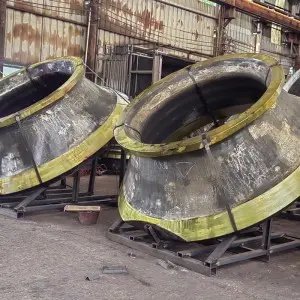
FAQ: Frequently Asked Questions About Crusher Parts Procurement
Q1: How can I identify a supplier with genuine capability, not just low prices?
A: Evaluate four points:
1. Material Traceability: Can they provide mill material certificates and incoming material records?
2. Process Documentation: Do they have complete heat treatment process cards and quality inspection records?
3. Testing Capabilities: Do they have basic equipment like spectrometers and flaw detection devices on-site?
4. Testing Capabilities: Do they have basic equipment like spectrometers and flaw detection devices on-site? Material Traceability: Can they provide mill material certificates and raw material records?
2. Process Documentation: Do they maintain complete heat treatment process cards and quality inspection records?
3. Testing Capabilities: Does the facility possess basic inspection tools like spectrometers and flaw detection equipment?
4. Application Cases: Can they provide verifiable operational data or customer feedback from similar working conditions?
Q2: Are imported brand parts always better than domestic ones?
A: Not necessarily. Many outstanding domestic manufacturers now possess world-class material science and casting capabilities. The key lies in the manufacturer’s technical expertise and quality control systems, not just the origin. Some premium domestic brands offer significant advantages in cost-effectiveness and localized service. We recommend “performance data benchmarking” over “origin bias.”
Q3: For clients with truly tight budgets, what compromise suggestions are available?
A: With limited budgets, adopt a “priority for critical components” strategy. For core wear parts that bear the most direct impact and significantly affect energy consumption and safety (e.g., jaw plates, impact hammers, liner plates), insist on high-quality products. For auxiliary components with relatively gradual wear and easy replacement, consider more cost-effective solutions. However, never downgrade all components across the board.
Choices are never simply about “expensive” versus “cheap.” In the realm of crusher components, true wisdom lies in recognizing total lifecycle costs and understanding that “reliability is the greatest benefit.” When you can see through the fog of “low prices” and measure every purchase against the Total Cost of Ownership (TCO) yardstick, you’ve already avoided the deepest potholes and embarked on the path to sustainable profitability. Remember: The most expensive is rarely the best; yet the best, over the long term, seldom proves the most costly.
Meta Description:
Paying the price for “low-cost” crusher parts? This article exposes hidden cost traps: high energy consumption, short lifespan, and safety hazards. We provide expert identification methods to help cross-border buyers and end-users make informed decisions, truly reducing Total Cost of Ownership (TCO).
Keywords:
crusher spare parts cost, equipment energy consumption analysis, spare parts lifespan assessment, low-price trap, mining equipment procurement
Post time: Jan-20-2026