
A cement plant in Southeast Asia awards a mill liner contract to a supplier with an impressive website, twenty product photos and a factory tour video. Eight months later a batch arrives with inconsistent hardness and dimensional variation that stops the installation. The video was a rented facility. The supplier was a trading office.
This happens constantly in cast wear parts, because the product is heavy, the buyer rarely visits, and the difference between a real foundry and a well-marketed intermediary is invisible on a screen. The questions below are written for cement plants, mining groups and crushing plant contractors qualifying a casting partner.
Why This Category Is Especially Vulnerable
Cast wear parts are bulky and expensive to ship, which discourages sample testing at real scale. They are sold on drawing and specification rather than on appearance, so a photograph proves very little. And the failure mode is slow: a bad batch is discovered months later, after installation, when the claim is nearly impossible to enforce.
The cost of qualifying a supplier properly is one video call and one sample analysis. The cost of getting it wrong is a full installation cycle.
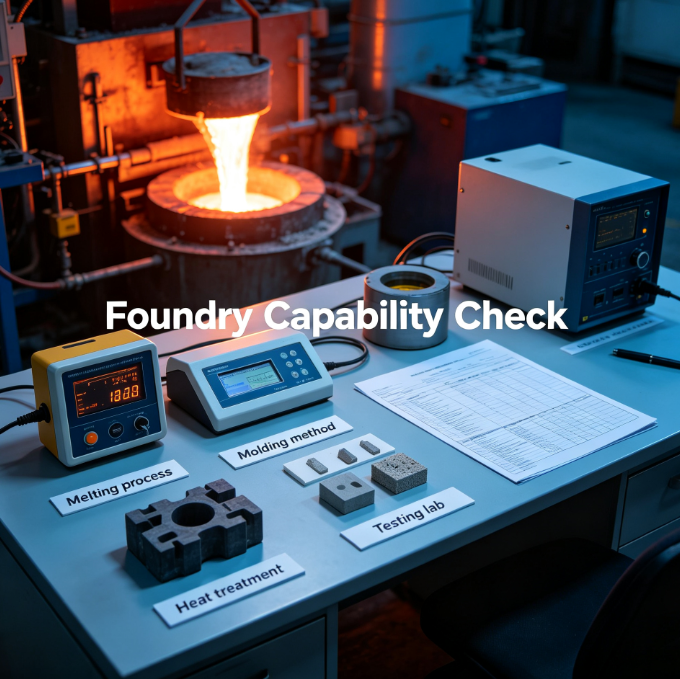
The Questions That Are Hard to Fake
1. What Is Your Melting Capacity and How Many Furnaces Run?
A real foundry knows this instantly: furnace type, capacity per heat, number of furnaces, and typical heats per day. An intermediary has to ask someone and come back later. Ask it on the call and listen to whether the answer arrives immediately.
Follow up with the practical question: what is the largest single casting weight you have poured? That figure constrains what they can actually make, and it is not something a sales agent invents well.
2. What Heat Treatment Equipment Do You Operate?
For manganese steel castings, water quenching is where the properties come from. Ask for quench tank dimensions, water temperature control, and the time from furnace to quench. A foundry that understands its own metallurgy will describe the process in detail without being prompted.
Ask what happens to water temperature during a full production day. It is a question only someone who has run a quench line answers comfortably, and the answer tells you whether hardness consistency is designed in or hoped for.
3. Can You Show the Spectrometer Reading for This Heat?
Every credible foundry runs a spectrometer on every heat and can produce the reading. Ask for the actual printout for a specific batch, with the heat number visible. Then ask for the heat number to be stamped on the casting.
Traceability is the single strongest indicator of a professional operation. If a supplier cannot tie a delivered casting back to a specific heat and its chemical analysis, you have no basis for a claim and no way to prevent a repeat.
4. Where Are the Patterns Made and Who Owns Them?
Ask whether the pattern shop is in-house and who owns the tooling. In-house pattern making shortens development considerably and tells you the foundry intends a long relationship. Tooling ownership should be stated in the contract: if you paid for it, you should be able to move it.
5. What Testing Happens Beyond Chemistry?
Look for hardness testing with a documented location, dimensional inspection with a report, and where relevant magnetic particle or ultrasonic examination of critical sections. Ask for a sample first article inspection report format before you place an order, so you know what documentation will arrive with the goods.
Running a Remote Audit That Actually Works
Travel is expensive, but a video audit done properly is surprisingly effective. The key is controlling the call rather than accepting a guided tour.
Ask for a live, unedited walk-through at a time you choose, not a scheduled production window.
Ask the camera operator to read a gauge or a control panel aloud with the value visible. Recorded footage cannot do this.
Request a shot of the current production board showing what is being poured this week.
Ask to see the raw material store and to name the supplier of their ferro-manganese or scrap feedstock.
Ask to speak to the melting shop supervisor directly, not through the sales contact.
One useful trick: ask for the view from the factory gate, then ask them to walk to the melting shop without cutting the feed. Edited tours always cut; real ones do not mind the walk.
Verifying Capability Against Your Actual Parts
General capability means less than specific experience with your casting. Ask for evidence they have produced the size and section thickness you need, because a foundry comfortable with 300kg castings may struggle with a two tonne mill liner.
Check that the range you need is produced in-house rather than assembled from subcontractors. A supplier that casts its own high manganese steel and machines its own mantles and bowl liners controls the whole process, which matters for dimensional accuracy at the mounting faces. The same applies to blow bars, where the balance between hardness and toughness determines whether the part wears or breaks.
Qualifying Before You Need It
The worst time to find a second source is during a shortage. Run the qualification exercise while your current supplier is performing well, keep the documentation on file, and place a small trial order to complete the process.
A qualified second source is insurance that costs one trial order. An unqualified one is a phone number that gives you nothing when you actually need it.
The Bottom Line
Ask about melting capacity, quench control, spectrometer records and heat number traceability, and ask the questions live rather than by email. Request a sample inspection report format before the first order, confirm tooling ownership in writing, and qualify a second source while things are calm. Then review the full casting and crusher parts range against the capability evidence rather than the catalogue.
Post time: Sep-14-2026