
In the highly competitive European construction aggregate market, aggregate purity and production efficiency are the two core indicators determining profitability. For European producers with established crushing lines, relying only on crushers (such as cone crushers or jaw crushers) is insufficient. Installing a high-performance sand washing machine at the end of the production line is often the critical step to upgrade ordinary aggregates into high-value-added products.
Europe’s strict environmental regulations and high-standard construction codes require aggregate products to have extremely low mud content and precise gradation. Traditional dry processing often struggles to meet these demanding requirements, especially when processing raw ore with high mud content. A sand washing machine is more than just a stone cleaning unit — it functions as an integrated grading and dewatering system. Through efficient washing processes, producers can significantly reduce the methylene blue (MB) value of finished products and remove harmful impurities (such as mica and organic matter), producing high-quality aggregates fully compliant with the EN 12620 standard.
Key Insight
For European buyers, investing in washing equipment should not be viewed as a pure cost center, but as a strategic investment to boost product premium. By removing impurities, a sand washing machine can transform ordinary crushed stone — once only suitable for subbase materials — into high-grade manufactured sand for high-strength concrete, directly increasing the selling price per ton.
In-Depth Analysis: How Sand Washing Machines Optimize Economic Benefits for European Production Lines
To help European plant owners and procurement managers fully understand the value of sand washing machines, we analyze their technical impact on production efficiency and purity metrics.
1. Improve Product Purity to Meet Strict EU Standards
In Europe, the mud content of construction sand directly affects the strength and durability of concrete. Excessive mud content not only causes quality inspection failure but also risks engineering accidents.
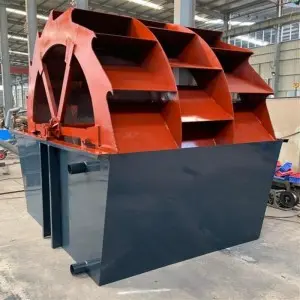
Removal of stone powder and clay: High-efficiency sand washing machines use water buoyancy and mechanical agitation to separate stone powder and clay particles smaller than 0.075mm from sand surfaces.
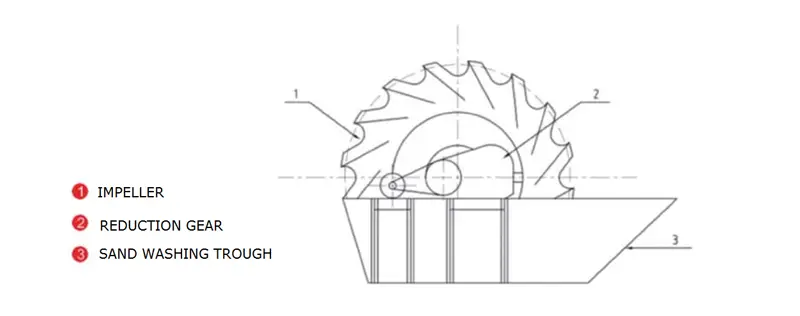
Control of fineness modulus: By adjusting the overflow weir height and impeller speed, producers can precisely control the fineness modulus (FM) of finished sand to achieve ideal gradation for different grades of concrete.
2. Boost Production Efficiency and Reduce Downtime & Maintenance Costs
Many European factories worry that wet processing lines will increase maintenance difficulty. In reality, modern wear-resistant sand washing machines significantly improve overall efficiency.
Wear-resistant material application: For high-wear environments, key components such as impellers and spiral main shafts are typically made of high manganese steel or high chrome cast iron, delivering exceptional abrasion resistance in hard rock washing and greatly reducing downtime caused by parts replacement.
Water recycling: Paired with fine sand recovery units and sludge filter presses, modern washing systems achieve over 90% water recycling rate, fully complying with Europe’s strict water conservation regulations and avoiding high sewage discharge fees.
3. Increase Product Added Value and Market Competitiveness
In the European market, clean white manufactured sand typically sells at a 15%–30% premium over ordinary gray crushed stone.
Product diversification: Washing allows factories to produce clean coarse aggregate, high-grade manufactured sand, and stone powder (usable for brick making), maximizing raw ore value.
Lower return risks: Stable high purity means fewer customer complaints and returns, preserving brand reputation in high-end markets.
Solutions: Building a Highly Adaptable Washing and Crushing System
Given Europe’s complex geological conditions and variable production demands, single equipment is rarely sufficient. Procurement decisions should prioritize system compatibility between complete machines and wear parts.
Synergy Between Crushing and Washing
The performance of a sand washing machine depends heavily on the particle shape from upstream crushers.
Cone Crusher: Used in secondary or tertiary crushing, it produces well-shaped aggregate with low needle-flake content, providing ideal feed for washing and reducing overload risks.
Impact Crusher: Provides good particle shaping but generates high stone powder, requiring efficient washing to remove excess fines and produce standard-compliant manufactured sand.
Scientific Selection of Wear-Resistant Materials
Material choice must align with rock hardness (Mohs scale) across European regions:
High manganese steel (Mn13, Mn18): Ideal for medium-hardness rock such as limestone, with excellent work-hardening properties.
Medium / high chrome cast iron: Suited for high-hardness, high-abrasion rock such as granite and basalt, offering extreme hardness and minimal deformation.
Alloy steel: Commonly used for structural components and drive shafts, ensuring structural strength in humid environments.
(Photo Caption: Crusher wear parts made of high chrome cast iron, demonstrating stable shape retention in high-wear conditions.)
Procurement Advice: Making the Smart Choice for Your European Plant
In the 2026 industrial landscape, European producers should follow this logic when sourcing sand washing equipment and related wear parts:
Analyze raw material characteristics: Evaluate mud content and hardness of your ore. A sand washing machine is essential if mud content exceeds 5% or high-grade concrete aggregate is required.
Focus on Total Cost of Ownership (TCO): Look beyond upfront pricing. Calculate wear part replacement frequency, water consumption, and fine sand loss. A higher-priced machine with long-lasting wear parts and water savings delivers lower long-term costs.
Ensure environmental compliance: Verify the washing system includes complete fine sand recovery and sludge dewatering modules to meet local discharge standards and avoid heavy fines.
Ultimately, investing in high-performance sand washing machines and premium wear parts is essential for European producers to maintain leadership in a competitive market by improving product quality and reducing operating costs.
#SandWashingMachine #EuropeanAggregateProduction #CrusherWearParts #HighManganeseSteelParts #HighChromeCastIron #ManufacturedSandWashing #SandWashingMachineSourcing #ConstructionAggregatePurity #ConeCrusherParts #WetProcessingProductionLinez
Post time: Apr-02-2026