
Project Management: Key Milestones for Buyers to Track from Contract Signing to Production Launch
Project Management: Key Milestones for Buyers to Track from Contract Signing to Production Launch represent the most overlooked yet critical issues affecting project efficiency for many cross-border buyers of crusher spare parts and B2B clients. Many buyers report blindly waiting for shipment after signing contracts while neglecting critical follow-up milestones. This often leads to substandard part quality, production delays, customs clearance issues, and even poor part compatibility during commissioning. These problems not only incur extra costs but also cause project schedule delays. Drawing on over a decade of hands-on experience in the crusher parts industry, this article clarifies the core follow-up milestones throughout the entire process from contract signing to production launch. It helps you navigate project pitfalls, ensuring efficient procurement and smooth production commencement. Let’s break down the key focus areas for each critical milestone.
First Post-Contract Milestone: Verify Supplier Qualifications and Capacity to Solidify Project Foundations
Many buyers mistakenly believe that supplier qualifications reviewed before signing require no further follow-up afterward. This is a significant misconception. Crushing equipment procurement projects involve long cycles and large volumes. Re-verifying qualifications and capacity after signing prevents suppliers from “dropping the ball” after securing the contract.
I previously worked with a cross-border buyer handling an African mining project. After signing a crusher parts supplier, they failed to verify capacity. The supplier simultaneously took on multiple orders and couldn’t produce on time, delaying parts delivery by 20 days. This directly caused the mining project schedule to fall behind, resulting in significant additional labor costs. Later, following my advice, they completed supplier verification within three days of signing. They promptly identified issues and adjusted production plans, avoiding greater losses.
The verification focuses on two key areas: First, qualification review—confirming the supplier’s production and testing certifications are complete and compliant with industry standards like JB/T 2259-2017. Second, capacity verification—ensuring the supplier’s production lines and workforce can meet the order delivery timeline. Many buyers ask if on-site factory visits are necessary. Not necessarily—requesting actual photos of production workshops, recent production schedules, and video verification when needed is sufficient. which saves time and enhances efficiency.
Production Phase Milestones: Dual Control of Quality and Progress to Avoid Start-up Risks
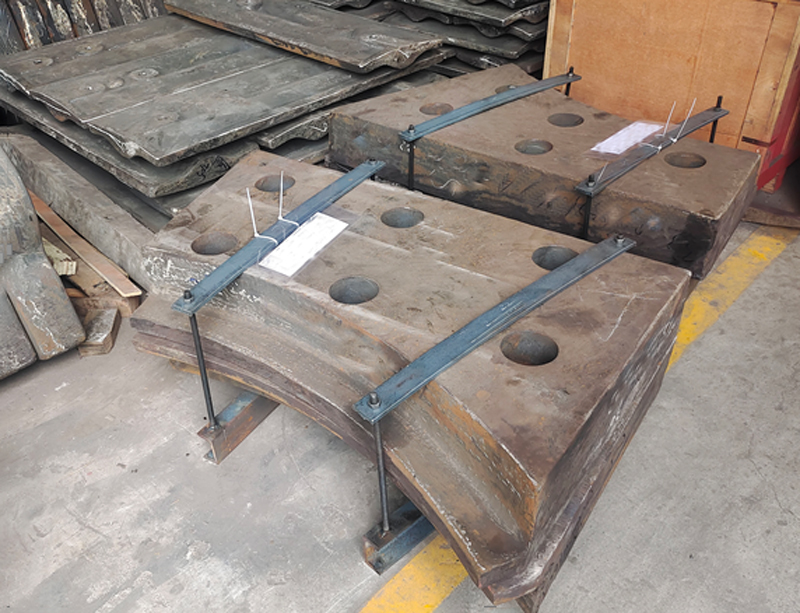
The production phase is the core of crusher spare parts procurement projects and the most prone to issues. Without buyer oversight, non-compliant parts may be delivered, rendering them unusable during start-up—especially critical components like impact plates and liners, whose quality directly impacts crushing efficiency.
Focus on two core areas: schedule tracking and quality control. For scheduling, conduct weekly supplier meetings to obtain production timelines, prioritizing critical component milestones like plate hammer forging or liner plate machining progress. For quality, mandate supplier testing against industry standards, closely monitoring key parameters such as plate hammer weight variation and rotor static balance.
Take hammer plate production as an example. A long-term procurement partner I worked with previously failed to monitor production quality. The hammer plates they received had excessive weight variation (exceeding the industry standard of ±0.5%). After installation, the rotor exhibited excessive vibration, bearing temperatures rose beyond acceptable limits, and normal operation was impossible. The parts had to be reworked and replaced, delaying the project by 15 days. After implementing quality monitoring requirements—including demanding weight inspection reports for each batch of hammers—such issues ceased entirely.
Many buyers ask: How can we monitor production throughout bulk orders? The solution is to establish key inspection milestones. For instance, request suppliers to promptly provide inspection videos and reports after hammer forging completion and rotor static balancing. Focus on verifying parameter compliance with contract specifications to effectively control quality.
Pre-shipment Inspection: Comprehensive Acceptance + Packaging Protection Tailored for Cross-Border Transport
Most crusher components are bulky and heavy, with some requiring high precision (e.g., hydraulic system parts). Pre-shipment inspection and protective packaging directly determine whether components arrive intact—a critical yet often overlooked step for buyers, especially cross-border purchasers. Issues here lead to cumbersome returns and replacements.
Acceptance should align with industry testing standards, employing a “static inspection + no-load test run” approach: Static inspection verifies part specifications, dimensions, and critical parameters—such as whether the gap between impact plates and counterplates falls within the 10-20mm standard range, and whether hydraulic systems are leak-free. A 2-hour no-load test run checks vibration levels, noise, and bearing temperature rise for compliance.
I previously worked with a client engaged in European cross-border procurement. The hydraulic system components they purchased for crushers lacked rigorous factory inspection and proper packaging protection. During transit, pipe joints loosened, causing hydraulic oil leaks, and some parts sustained impact damage and deformation. After customs clearance, the components were unusable, resulting in high repair costs and project delays. Subsequently, they enhanced their factory acceptance procedures. Each batch of parts now requires suppliers to provide no-load test reports before shipment, and custom protective padding is used during packaging. This approach has completely resolved such issues.
Regarding packaging protection, tailored measures should be applied based on part type:
- Precision components (e.g., vibration sensors) should be individually packaged with shockproof and moisture-proof treatment. Large components (e.g., racks) require reinforced packaging with clear center-of-gravity markings and fragile labels to prevent impact damage during transit. Many buyers ask: What packaging standards must be met for cross-border procurement? The key is to align with the destination country’s shipping regulations. Implement moisture-proof and rust-proof packaging to prevent dampness and mold during ocean freight. Clearly label component names and specifications to facilitate customs clearance.
Post-arrival milestones: Customs clearance follow-up + installation compatibility to ensure smooth production launch
For cross-border buyers, post-arrival customs clearance and installation compatibility mark the final critical juncture from procurement to production launch. For end buyers, post-arrival inspection and installation guidance directly determine whether a project can commence operations smoothly. Failure at this stage may render all prior efforts futile.
For customs clearance follow-up, the buyer must prepare relevant documentation (test reports, certification, packing list) in advance and coordinate with the supplier on clearance procedures. Pay close attention to environmental and safety standards in the destination country—for example, EU regions require test reports compliant with GB 25518 to avoid clearance delays.
For installation compatibility, require suppliers to provide detailed installation manuals and arrange remote technical guidance when necessary. Pay close attention to component compatibility, such as the installation precision of impact plates and rotors, and hydraulic system pressure calibration, to ensure the equipment operates normally after installation. One mining end-user I worked with previously installed equipment independently upon delivery. They failed to properly adjust the plate hammer clearance according to specifications, resulting in substandard material particle size during operation and accelerated plate hammer wear. Only after re-adjusting under supplier technical guidance did the equipment meet production requirements.
Many buyers ask: What if parts fit poorly upon arrival? Contracts can stipulate that suppliers provide complimentary installation guidance and compatibility debugging services. If compatibility issues prevent startup, suppliers must promptly rework or replace parts to safeguard buyer interests.
FAQ: Top 3 Frequently Asked Questions by Buyers
1. In crusher parts procurement, which stage is most prone to delays from contract signing to production launch?
Answer: Production and customs clearance stages are most susceptible to delays. For production, closely monitor core component manufacturing schedules to avoid supplier capacity constraints. For customs clearance, prepare documentation in advance and verify compliance with destination country standards to prevent clearance issues.
2. What key parameters should be inspected during acceptance for cross-border crusher spare parts procurement? Answer: Focus on checking hammer weight variation, rotor static balance, bearing temperature rise, hydraulic system leakage, and the gap between hammers and impact plates. Ensure all parameters comply with industry standards like JB/T 2259-2017 and contractual requirements.
3. How can buyers without specialized inspectors control component production quality? Answer: Establish key inspection milestones, requiring suppliers to provide inspection videos and reports while verifying core parameters. Alternatively, commission third-party testing agencies for spot checks or request suppliers to arrange remote technical demonstrations of inspection procedures to ensure quality compliance.
Summary
Ultimately, the smooth progress of crusher spare parts procurement projects is never “completed upon signing.” It requires end-to-end control of all process milestones from contract signing to production launch. Neglecting any milestone may lead to project delays and increased costs. For B2B buyers and cross-border procurement professionals, mastering these critical milestones helps avoid project pitfalls, boost project efficiency, reduce after-sales costs, and ensure the production needs of end customers are met. We hope this article helps clarify your follow-up approach, enabling precise control over each core milestone. This ensures a seamless journey from contract signing to production launch for crusher spare parts procurement projects. Project management—specifically the critical milestones buyers must track from contract signing to production launch—is the cornerstone of project success.
Meta Description
Are crusher parts procurement projects prone to delays and hidden risks? This article, authored by seasoned professionals in the crusher parts field and grounded in real-world project cases, meticulously breaks down the core follow-up milestones from contract signing to production launch. Covering qualification verification, production control, factory acceptance, and installation compatibility, it addresses high-frequency questions from buyers, helps you avoid project pitfalls, adapts to cross-border procurement needs, ensures efficient project advancement and smooth production launch, and empowers B2B buyers to excel in project management.
Keywords
Crusher Parts Procurement Project Management, Critical Milestones in Crusher Parts Procurement, Cross-Border Crusher Parts Procurement Follow-Up, Crusher Parts Production Quality Control, Crusher Parts Delivery Acceptance
Post time: Jan-30-2026