
Wear-Resistant Lining Plates: Replaceable high-manganese steel or alloy wear-resistant lining plates inside the machine body protect the main unit.
Wear-resistant lining plates are the core protective components of crushers. Many cross-border buyers experience frequent wear and replacement due to selecting incorrect plate materials or neglecting operational compatibility. This not only increases maintenance costs by 30%-50% but also often leads to severe failures involving wear damage to the main unit chamber. This article dissects the selection logic, procurement essentials, and maintenance techniques for high-manganese steel and alloy wear-resistant liners, helping you precisely match operational requirements. We begin with the most critical aspect: material selection.
I. High-Manganese Steel vs. Alloy Wear-Resistant Liners: How to Select for Compatible Conditions?
The material choice for wear-resistant liners directly determines service life, hinging on matching material properties and operational intensity. Each mainstream material type has distinct application scenarios, and selection should not be arbitrary.
High-manganese steel liners excel in impact resistance. When subjected to forceful impacts, their surface forms a hardened layer that becomes increasingly tough with wear, making them ideal for high-impact conditions. For instance, when crushing large, hard materials like basalt or granite, high-manganese steel liners effectively withstand material collisions.
Alloy wear-resistant liners emphasize high abrasion resistance, achieving enhanced hardness through the addition of elements like chromium and molybdenum. They are suitable for low-impact, high-grinding conditions, such as grinding powder in cement ball mills or conveying coal gangue in coal mine chutes.
Industry Case: A coal mine chute at Shanxi Coking Coal Group originally used high-manganese steel wear plates, which failed due to cracking every 3 months, incurring an annual replacement cost of 600,000 yuan. After switching to “high-chromium cast iron + nickel alloy” wear plates, service life extended to 18 months, reducing annual replacement costs to 120,000 yuan and generating direct annual savings of 480,000 yuan.
Common Question: Can both impact and abrasion demands be addressed simultaneously in complex operating conditions?
Composite wear-resistant liners can be selected. These liners use high-manganese steel as the base material to ensure impact resistance, with a surface overlay of high-chromium alloy to enhance wear resistance. For example, the movable jaw liner of a mining jaw crusher, when using composite material, achieves a service life 2-3 times longer than pure high-manganese steel.
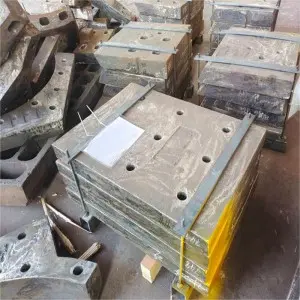
II. Selection Criteria: 3 Core Dimensions to Avoid Procurement Pitfalls
Selecting the right wear liner requires more than just material evaluation. It necessitates a comprehensive assessment considering equipment type, material parameters, and operational requirements—this is key to reducing long-term costs.
First, identify the equipment type and installation location. Jaw crusher plates require impact resistance, making high-manganese steel suitable; ball mill liners demand wear resistance, prioritizing high-chromium alloy materials.
Next, confirm core material parameters: hardness, particle size, and throughput. For crushing hard materials with compressive strength ≥200MPa, thick-walled high-manganese steel liners are required. When processing highly abrasive materials with high silica content, high-chromium alloy liners should be selected.
Finally, define operational requirements. These include desired service life, maintenance intervals, and budget constraints. For limited budgets and high-impact conditions, high-manganese steel is suitable. For prioritizing long-term stable operation, alloy liners offer better cost-effectiveness.
Industry Data: Industry research indicates nearly 40% of wear liner procurement disputes stem from mismatched material abrasiveness. Among these, premature failure due to using standard high-manganese steel for highly abrasive materials accounts for 55%.
Common Question: How to select precisely when specific material parameters are unknown?
Provide material samples and equipment models to suppliers. Reputable suppliers will offer tailored recommendations based on hardness testing and wear trials. Alternatively, procure small trial batches for real-world service life testing before finalizing bulk orders.
III. Cross-Border Procurement Essentials: Compliance & Quality Control Techniques
When procuring wear-resistant liners internationally, prioritize quality verification, compliance certification, and logistics assurance to prevent losses from information discrepancies.
Quality control must focus on key metrics. For example:
- High-manganese steel liners require manganese content ≥11% and hardness ≥200HB.
- High-chromium alloy liners require chromium content ≥12% and hardness ≥60HRC.
Require suppliers to provide material test reports.
Compliance certification is non-negotiable. Exports to the EU require CE certification, while shipments to the US must pass FDA food contact certification (if used for crushing food processing materials). Simultaneously, products must comply with China’s GB/T 24186-2009 standard for wear-resistant steel.
Logistics and packaging demand special attention. Given their heavy weight and high hardness, wear-resistant liners require moisture-proof and rust-proof packaging. For cross-border transport, container shipping is recommended to prevent deformation or corrosion during transit.
Industry Case: A European buyer procured alloy wear-resistant liners for ball mills without requiring CE certification. Upon arrival, the shipment was detained for failing EU safety standards. Re-certification delayed the project by 30 days and incurred additional costs of ¥150,000.
Common Question: How to safeguard after-sales rights in cross-border procurement?
Contracts must clearly stipulate quality commitments, warranty periods, and claim provisions. Require suppliers to provide after-sales service plans, including support for returns/replacements or reissuance for premature failures not caused by operational conditions. Retain material test reports and acceptance records for future claims.
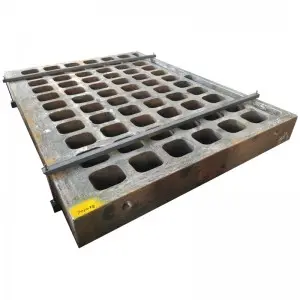
IV. Installation and Maintenance: Key to Extending Wear Plate Lifespan
Proper installation and maintenance can extend wear plate lifespan by over 30%, significantly reducing overall costs.
Ensure tight fitting during installation. Level the wear plates against the host chamber, fully tighten bolts to prevent vibration-induced impact that causes premature cracking. Install plates in numbered sequence to ensure even stress distribution.
Conduct routine inspections for daily maintenance. Weekly checks should assess liner wear and bolt tightness. Address any localized wear exceeding standards or loose bolts promptly to prevent liner perforation and subsequent damage to the main chamber.
Proper usage is equally critical. Avoid crushing oversized materials exceeding the equipment’s capacity to prevent excessive impact on liners. Regularly clear residual material from the crushing chamber to reduce continuous abrasion on liners.
Industry Case: At a Qilian Mountain Cement production line ball mill, improper installation of high-manganese steel liners caused vibration-induced wear, requiring replacement every 6 months. After standardized installation and switching to alloy liners, service life extended to 24 months, reducing annual replacement costs from ¥160,000 to ¥40,000.
Common Question: Should lining plates with minor cracks be replaced immediately?
If cracks are <50mm and do not extend to the plate edge, temporary continued use is permissible with shortened inspection intervals. Cracks exceeding 50mm or reaching the edge require immediate replacement to prevent plate fracture during operation and subsequent damage to the main equipment.
FAQ: High-Frequency Questions on Wear-Resistant Lining Plate Procurement
Q1: How much does the service life differ between high-manganese steel and alloy wear-resistant liners?
A1: Under identical impact conditions, their lifespans are comparable. However, in high-abrasion environments, alloy wear-resistant liners last 3-8 times longer than high-manganese steel. For example, in cement ball mills, high-manganese steel liners last 6 months, while alloy liners can reach 24 months.
Q2: What is the typical delivery cycle for cross-border procurement of wear-resistant liners?
A2: Standard custom products have a delivery cycle of 25-45 days. Special materials like composite wear-resistant liners require 45-60 days. Cross-border shipping via sea freight takes approximately 15-30 days. We recommend planning procurement 2-3 months in advance.
Q3: How can one assess the quality of wear-resistant liners?
A3: Beyond reviewing material test reports, inspect surface flatness and machining precision. High-quality liners exhibit no pores or cracks, with dimensional tolerances ≤±2mm. On-site hardness testing with a hardness tester must meet standard requirements.
Proper selection and procurement of wear-resistant liners are pivotal for ensuring stable crusher operation and cost reduction. By precisely matching materials to operating conditions, strictly controlling quality compliance, and adhering to standardized installation and maintenance protocols, wear-resistant liners can fully deliver their protective benefits. Selecting experienced suppliers and conducting scientifically informed procurement based on actual operational requirements transforms these liners into the “protective armor” for your primary equipment. Optimal liner selection and usage also provide a solid foundation for enhancing production efficiency.
Meta Description
This article provides cross-border buyers with detailed insights into material selection, procurement essentials, and installation/maintenance techniques for crusher wear plates, featuring real-world industry cases and data. It helps precisely match operational requirements, avoid procurement pitfalls, and reduce maintenance costs. Bookmark now to master professional guidance on wear plate procurement and usage!
Keywords
Wear-resistant liners, high-manganese steel wear liners, alloy wear liners, cross-border procurement of wear liners, crusher wear liner selection
Post time: Jan-06-2026