
Double-layer screen design: Enables the vibrating screen to complete multi-stage classification at one time
What is the greatest waste on the screening line? It’s not equipment depreciation or electricity bills, but rather breaking down a task that should be completed in one go into two steps. A single-layer screen can only provide you with two outlets: the top of the screen and the bottom of the screen. If the raw materials need to be divided into three or four specifications, two sets of equipment will have to be installed, taking up double the space and requiring double the labor. At this point, the advantage of the double-layer screen design becomes evident – it enables one vibrating screen to undertake two layers of screening tasks simultaneously, with materials flowing from top to bottom, achieving three-level classification at one time.
From a structural perspective, what are the advantages of double-layer screen mesh?
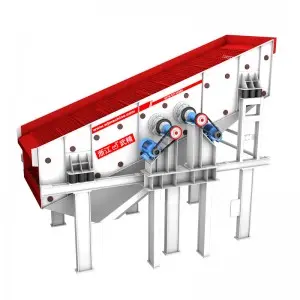
The basic structure consists of two layers of screens stacked vertically, with sufficient material buffer space left in the middle. The key lies in the configuration logic of the sieve holes. The upper screen mesh has a large aperture and is responsible for primary separation, keeping large pieces of material outside. The mesh size of the lower layer screen is small, allowing for fine classification. The excitation force generated by the vibrating motor is transmitted through the screen frame to the two layers of screen mesh. The amplitude and frequency remain consistent, but the residence time of the material on each layer can be controlled by adjusting the inclination Angle of the screen surface.
In practical applications, the upper screen surface is usually made at an Angle of 15 to 18 degrees to enable large particles to be quickly discharged and prevent accumulation. The inclination Angle of the lower screen surface is reduced to 10-12 degrees, which prolongs the screening time of fine materials and improves the efficiency of passing through the screen. This differentiated design increases the total processing capacity of the double-layer screen by 40-60% compared to the single-layer one, rather than simply doubling it. Feedback data from a certain cement plant shows that by replacing the original two single-layer screens with double-layer screens, the site occupation has been reduced by 35% and power consumption has decreased by 28%. This is not difficult to calculate.
How can the classification accuracy be guaranteed?
Some people are worried that when the two layers of screens work together, they might interfere with each other and affect the classification accuracy. This concern makes sense, but the solution is also very mature. Firstly, the height gap between the two layers of screens should be sufficient, at least 300 millimeters. This way, the materials screened from the upper layer will not directly hit the lower layer of screens but will first fall on the buffer plate and then be evenly spread out. Secondly, the tensioning method of the lower layer screen mesh should adopt hook type or mother-and-child mesh frame structure to ensure that the flatness of the screen surface is within 0.5 millimeters, avoiding local relaxation that may cause the material to deviate.
The selection of vibration parameters is more meticulous. The vibration intensity of a double-layer screen is generally between 5 and 6 grams, slightly higher than that of a single-layer screen. This is to overcome the increased inertia caused by the superposition of two layers of screen mesh. However, the vibration frequency should not be too high, usually maintained at 900 to 1200 revolutions per minute. If the frequency is too high, the material will jump too fast on the screen surface, and the screening will not be thorough. The amplitude should be controlled within 5 to 7 millimeters. This range not only ensures the screening efficiency but also does not reduce the service life of the equipment.
How to configure screens for different materials?
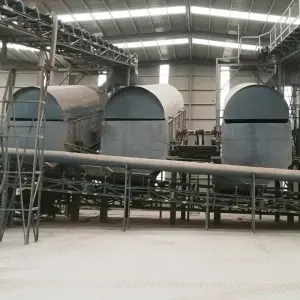
The double-layer screen on the crushed stone aggregate production line has a manganese steel woven mesh on the upper layer with a hole diameter of 40 millimeters and a polyurethane screen on the lower layer with a hole diameter of 5 millimeters. This configuration is due to the strong impact force exerted by large stones on the screen mesh, which requires a wear-resistant metal mesh. Polyurethane for fine aggregates has good elasticity and is resistant to clogging holes. The screening of chemical raw materials is the opposite. Both the upper and lower layers use stainless steel mesh, but the wire diameters are different. The upper layer uses 0.5-millimeter wire diameter to ensure strength. The lower layer uses 0.3-millimeter wire diameter to increase the opening rate.
The requirements of the food industry are more detailed. When sifting flour, use a 20-mesh nylon net on the upper layer, a 60-mesh stainless steel net on the lower layer, and add an ultrasonic cleaning net device in the middle. This combination not only meets food-grade hygiene requirements but also solves the problem of fine mesh clogging. The key is to choose a fully enclosed structure to prevent dust from spilling out. The grid structure should be of the stamping type, making it convenient to change the grid within 3 to 5 minutes. With less downtime, production capacity will naturally increase.
The key points of maintenance are easily overlooked
The fault points of double-layer screens are more than those of single-layer ones, but as long as a few key links are grasped, maintenance is not complicated. The tension of the screen mesh should be checked once per shift. Gently tap the screen surface with a rubber mallet and listen to the sound to determine if it is loose. The buffer plate should be inspected for wear and tear every month. If the thickness of the steel plate is ground from 10 millimeters to less than 8 millimeters, it needs to be replaced; otherwise, the material distribution will be uneven, affecting the screening effect of the lower layer.
The eccentric block Angle of the vibrating motor needs to be calibrated regularly. After half a year of operation of the double-layer screen, due to continuous vibration, the fixing bolts of the eccentric blocks may loosen, resulting in inconsistent amplitudes between the upper and lower layers. Stopping the machine for inspection once every quarter and re-tightening it with a torque wrench according to the specified torque can prevent many hidden problems. In addition, the compression height of the shock-absorbing springs should be inspected regularly. If the height difference among the four groups of springs exceeds 5 millimeters, the screen body will become polarized, accelerating the wear of the screen mesh.
How is the return on investment calculated?
The price of a double-layer vibrating screen is usually 30-40% higher than that of a single-layer one, but it replaces two single-layer screens. Take a 200-ton-per-hour aggregate production line as an example. The procurement cost of a double-layer screen may be 15-20% lower than that of two single-layer screens, the installation cost can be saved by 50%, and the floor space can be reduced by half. More importantly, the number of material transfers has decreased, and the investment in belt conveyors and hoppers has also dropped accordingly. Overall, the initial investment for the entire line can be reduced by 10 to 15%.
In terms of operating costs, the motor power of the double-layer screen is indeed larger. Two 3.5-kilowatt motors have a total power of 7 kilowatts, which is even lower than the 5 kilowatts ×2=10 kilowatts of two single-layer screens. Over the years, the electricity bill difference has been considerable. In terms of screen consumption, the service life of the upper and lower layers of the double-layer screen is longer than that of the single-layer one, because the material stays in each layer for a shorter time and the wear is relatively uniform. Actual usage data shows that the screen replacement cycle of the double-layer sieve can be extended by 20-30%.
Six questions to ask when selecting a model
What is the true particle size distribution curve of the material? This determines the matching relationship between the upper and lower layer sieve holes
2. What are the required processing capacity and classification accuracy respectively? When the processing capacity is large, the inclination Angle must be large. High precision requires a small inclination Angle
3. What is the moisture content and viscosity of the material? This concerns whether a net cleaning device needs to be added
4. What is the height limit of the installation site? The total height of a double-layer screen is usually between 2.5 and 3.5 meters
5. Is it necessary to adjust the process and increase the classification specifications in the later stage? Can the double-layer screen be conveniently transformed into a three-layer one
6. Can the supplier provide screening tests? It is most reliable to take 200 kilograms of raw materials for on-site testing and screening to see the actual data
The double-layer screen design is not merely a simple superposition of structures; it represents a rethinking of the screening logic. In modern factories where every inch of land is precious and against the backdrop of continuously rising labor costs, making equipment multi-functional with one machine is a practical choice. Rather than paying for additional equipment and management in the later operation, it is better to fully consider the classification requirements in the early selection stage. The core value of a vibrating screen, in the final analysis, lies in helping you sort raw materials clearly, accurately and quickly. The double-layer design precisely takes all these three points into account.
Post time: Dec-16-2025