
A cement plant in central Turkey fitted a new manganese liner set to its raw mill with the same crew, the same shims and the same habits used for fifteen years. Nine weeks later two liners had cracked and one had dropped. The foundry was blamed, then the chemistry. The steel tested 190 to 210 HB as cast with a clean austenitic structure. Nothing was wrong with the casting. It had gone onto a seat that was never cleaned, been tightened to whatever the impact wrench delivered, and run at full feed on the first shift.
The Casting Is Only Half the Product
A foundry delivers shaped steel with a hardness figure on a certificate. What the plant buys is tonnes before the next shutdown, and that number is produced on the seat, with a torque wrench and a feed ramp. Most premature casting failures are fitting failures, and they are rarely recorded as such, because nobody photographs the seat before the new set goes in and the argument is unwinnable months later.
Three conditions decide campaign life: full area contact on the seat, correct bolt preload and a controlled break-in. Miss one and the steel carries load it was never designed for. On a socket liner and eccentric bushing, all three apply to the bushing seat, and a bushing that turns destroys the head it sits in.
Seat Preparation and Point Contact
Wire brush the back face to bright metal free of old backing, scale and oil, then check flatness with a straightedge in four positions and record the largest gap. A 2 mm high spot carries the whole bolt preload on a few square centimetres, and the casting cracks outward from the back face, the fracture that gets reported as a steel defect.
Point contact punishes manganese badly, because its yield strength is low under the hardened skin and it deforms locally rather than spreading the load. Where the seat is damaged, a thicker shim is not the answer. Dressing the seat costs an hour and buys the campaign, so log the flatness reading before and after.
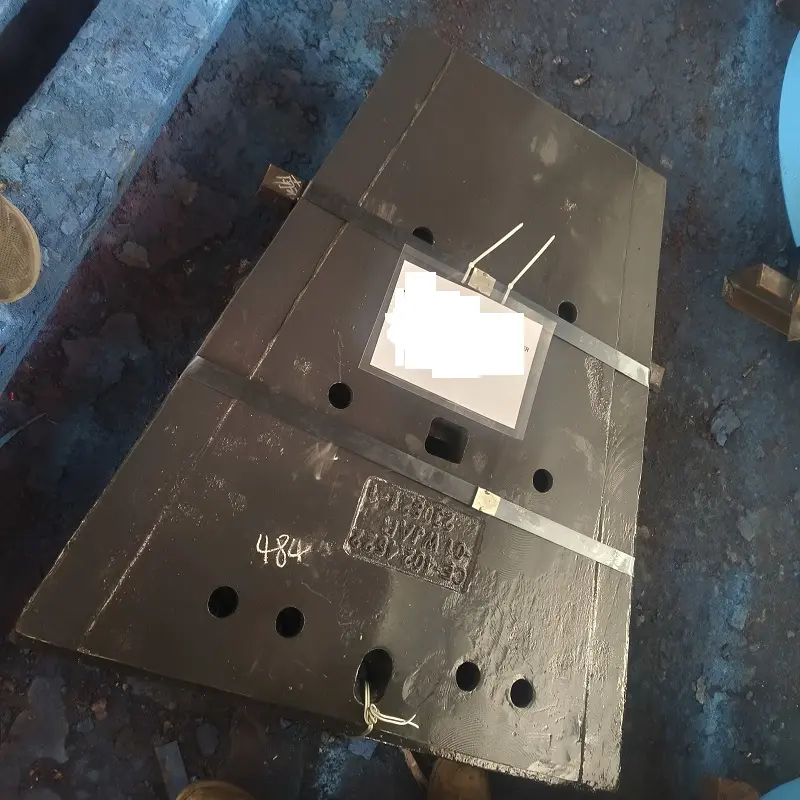
Backing: Resin, Shim or Nothing
There are three options and they are not equivalent. Bare metal to metal is correct only where both faces are flat within about 0.2 mm. For cast seats, resin or epoxy backing is the default, because it fills every void and spreads load across the whole back face.
Specify resin by compressive strength and bond line: at least 90 MPa cured over 3 to 6 mm. Backing thicker than 10 mm creeps, the bolts lose preload and the casting moves. Plywood compresses unevenly and lead and zinc shims cold flow. On liners for shredder and scrap duty, get the cure time and temperature range in writing.
Torque, Sequence and the Re-Torque
Use a calibrated torque wrench or tensioner and a value set by diameter, grade and lubrication. For dry threads, M24 in grade 8.8 sits near 690 Nm, M30 near 1,370 Nm, M36 near 2,390 Nm. Lubricated threads need 25 to 30 percent less torque for the same preload.
Tighten in a star pattern in three passes at 30, 60 and 100 percent. Then re-torque after 8 to 24 running hours, again near 100 hours, then at each inspection. Skipping the first re-torque is the top cause of loose liner bolts. Log every value.
Break-In: Work Hardening Needs a Ramp
New austenitic manganese leaves the foundry near 200 HB and reaches 500 HB only by being worked, which does not happen at full rate. Ramp it: 25 percent of design feed for eight hours, 50 percent for the next 24, then 75 percent to the end of week one.
The same applies to impact parts. A freshly seated mantle and bowl liner pair should run at reduced rotor feed for the first shift with graded, tramp-free feed. A documented break-in schedule beats a hardness certificate, because the certificate describes the steel as delivered, not as used.
The First 24 to 72 Hours
Inspect at 8, 24 and 72 hours for four things: backed-off bolts, marked at fitting with a paint line across nut and seat; fretting dust at the joint, which means the casting is moving; bright contact marks on the back face; and any new crack at a corner or rib. A millimetre of movement breaks a bolt in days, so stop and re-torque at once. Photograph every inspection and file the images with the job record, because the dispute about who pays starts months later.
Thermal Gaps, Records and Handover
Mill liners expand. Steel grows by 12 micrometres per metre per degree, so the rule is 1.2 mm of free expansion per metre for every 100°C of rise, spread across the end gaps. Fit at ambient and never butt liners hard together; on long shells, circumferential gaps matter equally.
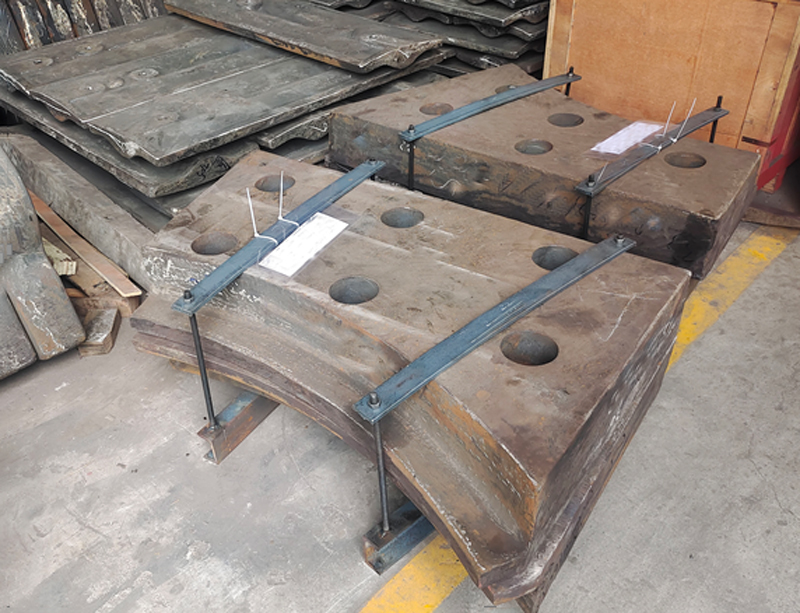
Demand the following in writing before the shutdown is booked.
A part-specific installation procedure, not a generic leaflet.
Torque values by size and grade, with the lubrication state.
Backing specification: strength, bond line, cure time, temperature range.
A break-in schedule with feed limits by running hour.
Recommended thermal gaps for the operating temperature.
A record sheet for weight, heat number, torque, dates and hours.
The Bottom Line
A casting that cracks at nine weeks was installed in a way that made nine weeks inevitable. Clean and measure the seat, control the backing thickness, torque in a star pattern and re-torque at 8 to 24 hours, and ramp the feed so the face can harden. Run all four and the campaign dispute with the foundry stops happening. The same discipline belongs on a compound pendulum jaw crusher, whose wedge and toggle bolts are logged on the identical schedule.
Post time: Sep-10-2026