
In mining and aggregate production, jaw plates represent a significant and recurring operational expense. For global procurement managers, understanding what drives jaw plate pricing is far more valuable than simply comparing quotes. This knowledge empowers you to make cost-effective decisions that optimize the total cost of ownership (TCO) for your crushing operation.
The price of a jaw crusher liner is not a fixed number; it is a calculated outcome based on material grade, dimensional specifications, manufacturing processes, and market dynamics. This guide dissects the core factors influencing the cost of crusher jaws.
Material Grade: The Foundation of Cost and Performance
The metallurgical composition of a jaw plate is the primary determinant of its price, wear life, and suitability for specific applications.
Manganese Steel (Mn Steel)
Manganese steel remains the industry benchmark for jaw crusher wear parts, renowned for its exceptional toughness and work-hardening properties under impact.
Cost Position: Mid-range. Offers the best overall value for a wide array of applications.
Application Scenario: Ideal for crushing highly abrasive materials like granite and basalt where impact loads are present. The surface hardness increases dramatically upon impact, extending service life.
Key Advantage: Excellent resistance to cracking and breaking.
Alloy Steel
By incorporating elements like Chromium (Cr) and Molybdenum (Mo), alloy steel achieves higher initial hardness and wear resistance compared to standard manganese steel.
Cost Position: Medium-High. Higher upfront cost than Mn Steel, justified by extended life in specific contexts.
Application Scenario: Performs well with medium-abrasive materials or in applications requiring enhanced wear resistance without extreme impact.
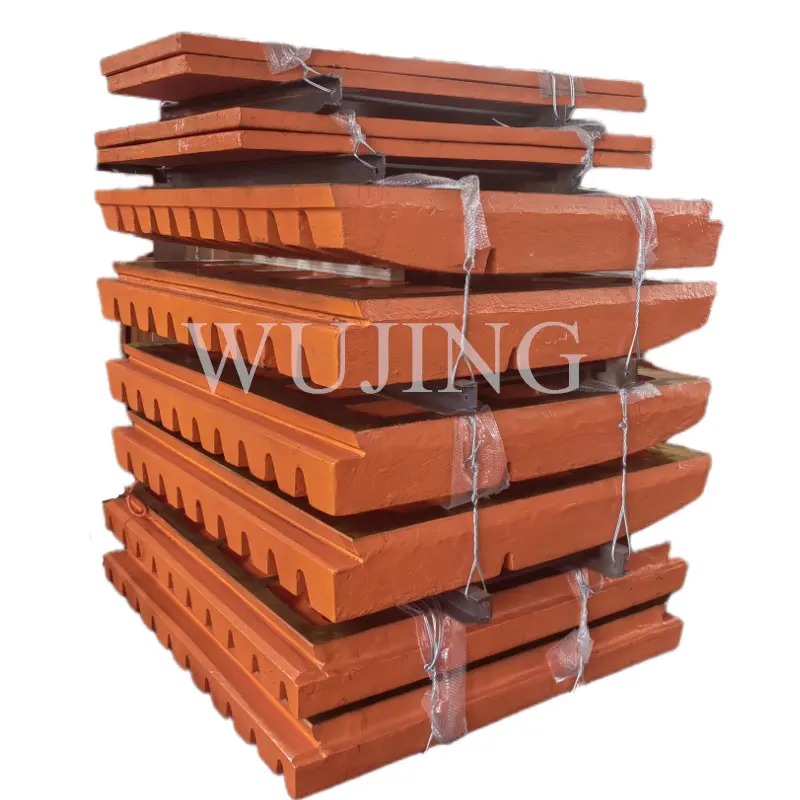
High Chrome Iron
High chrome iron offers superior hardness, ranking among the most wear-resistant materials available for jaw plates.
Cost Position: High. Elevated costs stem from both raw materials and complex casting requirements.
Application Scenario: Engineered specifically for extremely abrasive materials such as quartz and gravel. While the initial investment is significant, the exceptional lifespan drastically reduces change-out frequency and associated downtime costs.
Key Advantage: Maximum abrasion resistance.
Medium Chrome Iron
Serving as a bridge between high chrome iron and manganese steel, medium chrome iron strikes a balance between wear resistance and toughness.
Cost Position: Medium-High.
Application Scenario: Suited for moderately abrasive materials with incidental impact. It is the optimal choice for operations seeking longer life than manganese steel without requiring the extreme abrasion resistance (and higher cost) of high chrome iron.
Specifications & Design: Customization Costs
The physical dimensions and design complexity of jaw dies directly influence material consumption and manufacturing overhead.
Size and Weight: Larger jaw plates for heavy-duty primary crushers consume significantly more raw material than those for smaller units. Pricing correlates strongly with weight.
Tooth Profile (Jaw Design): Standard profiles (e.g., straight, smooth) utilize existing tooling. Custom profiles—such as corrugated, wedge, or ribbed patterns—engineered for specific output gradation or crushing efficiency, require bespoke pattern/mold creation. These tooling costs are amortized into the unit price.
Fitment and Configuration: Precise matching to your crusher model (e.g., fixed jaw, swing jaw, MTM configurations) is critical. Custom engineering or reverse engineering for older or non-standard models may incur additional design fees.
Manufacturing Process & Quality Control: The Hidden Value Drivers
Manufacturing rigor separates premium suppliers from budget alternatives. Superior processes ensure consistent performance and longevity.
Casting Technique: Advanced methods like lost foam casting yield denser internal structures and tighter dimensional accuracy compared to traditional sand casting. While more expensive, this reduces defects like shrinkage cavities that lead to premature failure.
Heat Treatment: Precise, controlled heat treatment cycles are essential to unlock the specified mechanical properties (hardness and toughness) of the selected alloy. Substandard heat treatment negates the benefits of high-grade materials. Investment in sophisticated thermal processing equipment is reflected in the final price.
Quality Assurance (QA): Rigorous QA adds cost but mitigates field failure risks. This includes:
Spectrometer analysis of incoming molten metal (chemical composition verification).
Post-heat treatment hardness testing.
Non-destructive testing (ultrasonic inspection) to detect internal flaws.
Dimensional audits against technical drawings.
Market Dynamics & Supply Chain Factors
External variables beyond the factory floor also impact your final landed cost.
Raw Material Volatility: Global prices for iron ore, ferroalloys (Mn, Cr, Mo), and energy directly influence foundry surcharges.
Order Volume (Economies of Scale): Bulk purchases typically command lower per-unit pricing by spreading fixed costs (tooling, setup, logistics).
Logistics & Tariffs: Ocean freight rates, insurance, port handling charges, and import duties in the destination country constitute a significant portion of the CIF (Cost, Insurance, Freight) or DDP (Delivered Duty Paid) price.
Conclusion: Shift from “Price” to “Value”
Effective procurement evaluates cost-per-ton rather than just acquisition price.
Cost Per Ton = (Jaw Plate Price + Labor Cost + Downtime Loss) / Total Tonnage Produced
Investing in higher-priced, longer-life jaw plates often reduces the frequency of change-outs, minimizes unplanned downtime, and lowers the effective cost per ton of crushed material. Engage your supplier with detailed information about your feed material, desired output, and crusher model. Selecting the optimally matched material grade and specification is the definitive strategy for achieving the lowest operational cost.
Post time: Jul-27-2026