
In the world of aggregate production and mining, mantle and bowl liner are two of the most critical cone crusher wear parts. While they work in tandem to crush rock, confusion between these components often leads to incorrect orders, unexpected downtime, and inflated operating costs. For B2B buyers and service engineers, understanding the distinct roles, material science, and failure modes of these liners is essential for optimizing crusher performance and maintaining lean inventory levels.
1. Definition & Installation: The Inner Core vs. The Outer Wall
The primary distinction lies in their physical location within the crushing chamber and their functional relationship.
Mantle (Moving Liner)
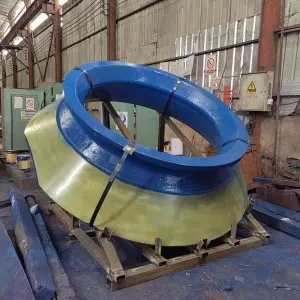
The mantle is the removable, wear-resistant steel layer mounted directly onto the cone crusher’s main shaft (the crushing head). It forms the inner surface of the crushing cavity. As the shaft gyrates at high speed, the mantle moves eccentrically, periodically closing the gap with the bowl liner to compress and break the feed material.
Bowl Liner (Stationary Liner / Concave)
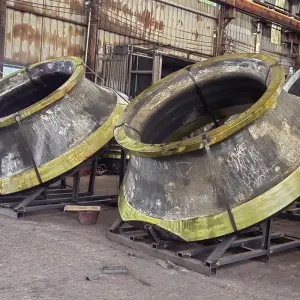
The bowl liner, often referred to as the concave, is secured to the stationary adjustment ring or bowl. It forms the outer shell of the crushing chamber. Unlike the mantle, it remains static during operation. Together, these two surfaces create a narrowing space where the rock is trapped and fractured.
Analogy: Visualize the crushing chamber as a large funnel. The mantle is the oscillating inner core, while the bowl liner is the fixed outer wall. Their relative motion defines the entire crushing process.
2. Operational Mechanics: Dynamic Stress vs. Static Pressure
Their positions dictate fundamentally different mechanical stresses, which in turn influence replacement schedules and material selection.
Mantle: High Impact Dynamics
As the moving component, the mantle endures severe impact fatigue. It must not only fracture the rock but also guide the material downward through the chamber. Consequently, the mantle requires exceptional toughness to prevent catastrophic failure (cracking or breaking) under sudden loading, such as when tramp metal enters the feed.
Primary Failure Mode:Cracking due to insufficient impact resistance or premature wear on the lower section due to high abrasiveness.
Bowl Liner: Compressive Grinding
The bowl liner absorbs massive compressive forces. While it experiences less direct impact than the mantle, its profile (the “chamber design”) dictates the final product’s gradation and particle shape. Wear on the bowl liner directly alters the Closed Side Setting (CSS), affecting throughput and product quality.
Primary Failure Mode:Abrasive wear, “Relief” (loss of profile), and thinning near the feed opening.
3. Metallurgy & Material Selection: Toughness vs. Hardness
Selecting the correct alloy for each part is a balancing act between abrasion resistance and structural integrity.
Mantle Materials: Prioritizing Toughness
Given the high-impact environment, High Manganese Steel (Mn13Cr2, Mn18Cr2, Mn22Cr3) is the industry standard for mantles. Under impact, the surface work-hardens (up to 550 HB), while the core retains ductility. For extremely hard ores, TiC (Titanium Carbide) inserts or composite castings are increasingly used to reinforce high-wear areas without sacrificing the necessary toughness to prevent breakage.
Bowl Liner Materials: Prioritizing Wear Life
While manganese steel is common, bowl liners often benefit from higher carbon content. High Chrome Iron (Cr26) offers superior abrasion resistance in non-impact, high-silica applications. However, for primary stages with large feed size, manganese steel remains the safer choice to avoid cracking. The choice depends entirely on the abrasive index of the processed material.
4. Procurement Implications: Why Distinction Matters
For wholesale distributors and quarry managers, failing to distinguish between these parts results in costly errors:
Incorrect Inventory: Ordering a “Mantle” when a “Bowl Liner” is needed causes immediate downtime.
Mismatched Alloys: Using a high-chrome mantle in a high-impact application will lead to shattering; using a low-manganese bowl liner in abrasive sand might halve its service life.
Chamber Configuration Errors: Mixing old and new liners, or liners from incompatible profiles (e.g., Standard vs. Short Head), ruins the crushing efficiency.
Pro-Tip for Buyers: Always provide the supplier with four data points: Machine Model (e.g., Metso HP400), Part Name, OEM Part Number, and Material Specification (e.g., Mn18Cr2).
Conclusion
The mantle and bowl liner are complementary yet distinct components in a cone crusher. The mantle is the dynamic core focused on impact absorption, demanding high toughness. The bowl liner is the static perimeter focused on compressive grinding, where profile retention is key. Mastering this distinction allows B2B buyers to source smarter, reduce cost per ton, and ensure maximum uptime across their fleet.
Post time: Jul-31-2026