
A cement plant received a batch of mill liners that passed dimensional inspection, passed visual inspection, and then cracked through the bolt holes within nine weeks. The material certificate was complete and looked entirely professional. What it did not show was a phosphorus figure of 0.09 per cent, well above the 0.06 maximum the specification called for, and phosphorus in manganese steel segregates to the grain boundaries and makes the casting brittle in exactly the places that carry load. One number on one certificate would have caught it. This is why the certificate, not the casting, is where a foundry is really judged.
The Composition Ranges That Matter
Austenitic manganese steel is defined by its carbon to manganese balance, and the common grades behave differently. Mn13, around 1.2 per cent carbon and 13 per cent manganese, is the general purpose work hardening grade. Mn18 and Mn22 carry more manganese for higher work hardening capacity and better toughness in heavy impact. The manganese to carbon ratio should sit at or above ten to one, because a lower ratio leaves excess carbon to form carbides.
The elements to police are the ones that hurt. Phosphorus above roughly 0.06 per cent causes grain boundary embrittlement and is the single most common cause of premature cracking. Sulphur forms inclusions and is normally held below 0.04. Silicon raises fluidity during pouring but above about 0.6 per cent promotes carbide formation. Chromium and molybdenum are sometimes added deliberately for specific duties, and a certificate that shows them should be questioned, not assumed to be an improvement, because they change the heat treatment window.
Heat Treatment Is Where the Properties Are Made
As cast manganese steel is not tough. It contains a network of carbides at the grain boundaries and will fail in service quickly. The properties come from water toughening, also called solution annealing: the casting is heated to roughly 1,050 to 1,100 C and then quenched rapidly in water. Done correctly this dissolves the carbides and leaves a fully austenitic structure. Done badly it leaves carbide remaining at the boundaries, and the part looks fine and fails in service.
The certificate should therefore show more than chemistry. Ask for the quench temperature, the time at temperature and the water temperature before and after quenching. A foundry that quenches into warm water because the tank is undersized produces castings that will not pass a microstructure check. Request a photomicrograph at 100x showing the grain boundary condition for the first article of any new supplier, and repeat it on audit. This single test separates competent foundries from the rest faster than any factory tour.
Hardness, Impact and the Numbers Buyers Misread
Two mechanical figures appear on most certificates and both are routinely misinterpreted. Brinell hardness in the as delivered condition should be around 200 to 250 HB for properly solution treated manganese steel. A reading of 300 HB or higher suggests retained carbides or incomplete treatment, and a buyer should treat a high as delivered hardness as a warning rather than as extra wear resistance, because the working hardness develops under impact in service, not in the foundry.
Impact toughness is the more meaningful test. A Charpy V notch result at ambient temperature for good manganese steel should be well above 100 joules, and many specifications call for testing at sub zero temperatures where the margin matters. Ask for the test temperature and the specimen location within the casting, because a test coupon poured separately is not the same as a sample cut from the part. For impact loaded components such as impact crusher blow bars, that distinction is worth more than any other line on the certificate.
Matching Grade to Duty
Specifying the highest grade everywhere wastes money. Mn13 remains correct for moderate impact and general crushing duties. Higher manganese grades earn their premium where impact is severe and the section is thick, because the work hardening response is what protects the part. For gouging abrasion with low impact, manganese steel may be the wrong family altogether and a martensitic alloy or a high chrome iron will outlast it despite being more brittle. Ask the foundry which duty the part sees and let them propose.
The same logic runs through the rest of a crushing plant. Shredder and metal crusher liners see impact and abrasion together, so the grade has to serve both.
By contrast, shredder anvils take concentrated shock loading and need toughness above all else.
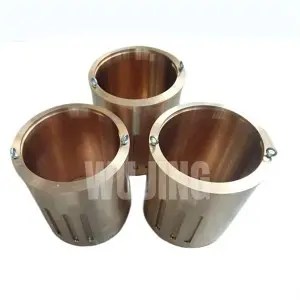
Precision fitment parts such as the socket liner and eccentric bushing are a different specification problem entirely, where dimensional accuracy governs rather than wear.
The Certificate Checklist for Every Shipment
Heat number traceable to the specific casting, not to the batch.
Full chemistry with carbon, manganese, silicon, phosphorus and sulphur all shown.
Manganese to carbon ratio at or above ten to one.
Phosphorus at or below 0.06 per cent, stated explicitly.
Solution annealing temperature, time at temperature and quench water temperature.
Brinell hardness in the as delivered condition, with the expected range noted.
Charpy impact result with the test temperature and specimen location.
Microstructure photograph at the first article and on every audit.
What to Do When the Numbers Are Missing
A foundry that cannot produce a full heat specific certificate is telling you something about its process control. Certificates issued per batch rather than per heat cannot support a root cause investigation when a part fails, and in a cement plant or a mining operation, failure analysis is the whole point of the paperwork. Where a supplier cannot provide the data, independent spectrographic testing on a cut sample costs very little next to a liner failure, and the result will tell you whether to keep the account.
The Bottom Line
Buy the certificate, not the casting. Check the manganese to carbon ratio and the phosphorus figure, confirm the quench conditions and the as delivered hardness, demand impact values with a stated test temperature, and match the grade to the actual duty. Plants that enforce this see liner and blow bar life become predictable, and predictability is worth more than any single extra week of wear.
Related Pages
Jaw Plate Pricing Guide: Cost Analysis by Material Grade
Mantle vs Bowl Liner: Key Differences Every Aggregate Buyer Must Know
OEM vs Aftermarket Crusher Wear Parts
Post time: Sep-24-2026