
At the installation site of the crusher, we often pay attention to the hoisting, positioning and commissioning of the equipment itself. However, a crucial yet easily underestimated link is often buried deep beneath the ground – that is the concrete foundation. It is far from a simple concrete pier; rather, it is the physical core for the stable operation, extended service life and safety guarantee of the entire crushing system. Selecting a basic design and strength that matches the dynamic load and type of equipment is not a cost item but a key factor in ensuring production continuity and return on investment.
Why can’t basic design be “one-size-fits-all”?
Imagine that the force transmitted to the foundation by a hammer crusher rotating at high speed is fundamentally different from that of a jaw crusher moving in a circular motion through an eccentric shaft. The former is accompanied by high-frequency vibration, while the latter generates periodic eccentric moments. If the basic design is uniform, it may lead to loose bolts, premature wear of components and a decrease in output at the very least. In severe cases, it may cause foundation cracking, equipment displacement, and even structural safety accidents.
Therefore, a qualified basic design must shift from “passive load-bearing” to “active response”. It needs to meet several core requirements simultaneously: sufficient mass and rigidity to suppress harmful amplitudes; Precise positioning of embedded parts to ensure installation accuracy; And structural designs that conform to local geological conditions. This brings us to our core issue: What are the key considerations in the basic design of mainstream types of crushers?
Analysis of the Key Points of Basic Design for the Main Types of Crushers
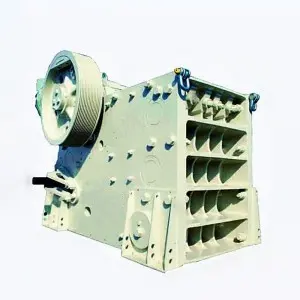
1. Jaw crusher: Capable of withstanding periodic impact loads
As the “main force” in the coarse crushing stage, when the jaw crusher is in operation, the moving jaw squeezes and crushes the materials, generating significant unbalanced forces and impact vibrations. The key to its basic design lies in “mass damping” and “integrity”.
The foundation usually needs to have sufficient mass (generally 3 to 5 times the mass of the equipment) to absorb and dissipate these impact energies.
The foundation should be designed as a solid integral reinforced concrete block to avoid split structures, so as to prevent displacement of each part due to uneven force.
In areas with relatively loose soil, such as certain alluvial plain sites, it is even more necessary to consider deepening the foundation or using pile foundations to enhance the bearing capacity, to prevent uneven foundation settlement from causing changes in the size of the equipment opening and affecting the particle size of the output.
2. Cone crusher: Balanced and precise operation
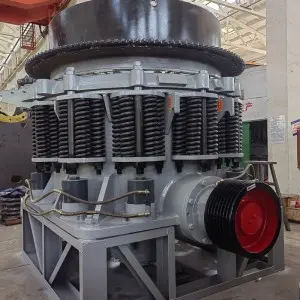
The cone crusher exerts less vibration and impact on the foundation than the jaw crusher, but its operation places more emphasis on precision and balance. It has extremely high requirements for the rigidity and levelness of the foundation.
The basic design focuses on providing extremely high rigid support to avoid any flexible displacement that might cause deformation of the main frame.
The top surface levelness of the concrete foundation is required to be extremely strict, which is the key to ensuring the meshing accuracy of gears and the uniform service life of liners. A foundation with poor levelness will directly lead to uneven force distribution inside the equipment, causing premature failure.
In areas with large temperature differences between day and night or seasonal frozen soil, the foundation design must take into account the influence of temperature stress and frost heaving. If necessary, an insulation and anti-freezing layer should be set at the bottom of the foundation.
3. Impact/Hammer crusher: Manages high-frequency vibration
This type of high-speed rotating impact crusher is a typical “vibration generator”. The core idea of its basic design is “isolation” and “attenuation”.
It is generally recommended to adopt an independent foundation completely separated from the factory building foundation, and to install professional vibration isolation pads or spring vibration isolators between the equipment base and the foundation to prevent vibration from being transmitted to the surrounding structures and buildings.
The foundation itself needs to have sufficient mass and reinforcement to counteract the fatigue stress caused by high-frequency vibration. For mine sites located on hard rock foundations, this isolation design can effectively protect the safety of other nearby precision equipment and building structures.
Beyond Type: Common Requirements and Professional Advice
No matter which type it is, several general principles must be adhered to
Concrete strength grade: Generally no less than C30, and it is necessary to ensure a sufficient curing period until it reaches the designed strength before installation.
Embedded parts (anchor bolt boxes) : Their positioning accuracy is the lifeline of the installation work. Stable steel formwork must be used for precise fixation to prevent displacement during the pouring process. The selection of secondary grouting materials (such as non-shrinking high-strength grouting materials) is also of vital importance.
Load analysis: Structural calculations should be carried out strictly based on the dynamic load diagram provided by the equipment manufacturer (not just the static weight), and the impact load when crushing the maximum material diameter should be taken into consideration.
When designing the foundation for a specific device, the safest approach is to closely rely on the official foundation drawings provided by the device manufacturer. These drawings are specially calculated based on the dynamic characteristics of the equipment. At the same time, providing the design party with a detailed local geological investigation report is another prerequisite for ensuring the safety and economy of the foundation.
Conclusion: A solid foundation is the guarantee of productivity
In the crushing production line, the concrete foundation is the silent guardian. A foundation tailored to the type of equipment and well-constructed can maximize the absorption of vibration, ensure centering accuracy, and reduce unplanned downtime, thus laying the most solid physical foundation for the efficient and long-life operation of the entire crushing system. It is a one-time investment, but it is a key investment that runs through the entire life cycle of the equipment and continuously generates returns. When planning new projects or relocating equipment, giving equal attention to basic engineering and mainframe equipment is a demonstration of vision and responsibility by every professional.
Post time: Dec-08-2025