
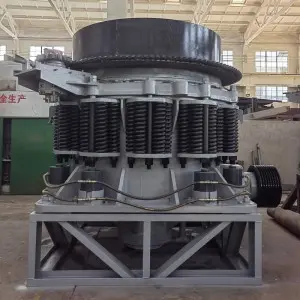
For mining and quarrying operators, the stable operation of cone crushers is the lifeline of production efficiency. As the core wear parts of cone crushers, the performance of Bowl Liners and Mantles directly determines equipment downtime, maintenance costs, and final output profitability. Faced with a wide range of products on the market, how do you define and select high-quality liners? This depends not only on materials but also on a series of precise technical parameters.
This article analyzes the essential key parameters for evaluating high-quality cone crusher liners to help you make informed purchasing decisions.
1. Material & Chemical Composition: The Foundation of Performance
Material is the basis of all liner performance. Different ore characteristics and crushing conditions require alloys with specific chemical compositions.
High Manganese Steel
This is the most classic liner material, such as Mn13Cr2, Mn18Cr2.
Its core feature is work-hardening: under strong impact and pressure, surface hardness increases sharply for exceptional wear resistance, while the interior retains high toughness to absorb impact energy.
High-quality manganese steel liners must undergo strict solution treatment to ensure full carbide dissolution and a uniform austenitic structure.
Alloy Steel
By adding chromium (Cr), molybdenum (Mo), nickel (Ni) and other elements, alloy steel achieves an optimized balance between hardness and toughness.
It is suitable for medium-impact, high-abrasion conditions and delivers more stable service life than traditional manganese steel.
High Chromium Iron
With extremely high hardness and excellent wear resistance, but relatively lower toughness.
It is ideal for fine crushing applications with low impact and strong abrasion.
During procurement, require suppliers to provide detailed chemical composition analysis reports to ensure material ratios match your actual working conditions.
2. Heat Treatment Process: Unlocking Material Potential
Cast blanks are only semi-finished products. Heat treatment is the critical step that gives liners their functional performance. Even with identical chemical composition, different heat treatment processes result in vastly different final properties.
Solution Treatment
For high manganese steel, the material is heated to a specific high temperature and held to fully dissolve carbides into austenite, then rapidly water-quenched.
This process directly determines whether the liner can achieve effective work-hardening in service.
Quenching and Tempering
For alloy steel and high chromium iron, precise control of quenching temperature and tempering cycles forms an ideal martensitic matrix, ensuring high hardness with sufficient toughness to resist fracture.
Manufacturers equipped with large, accurately temperature-controlled heat treatment furnaces provide the hardware guarantee for producing high-quality liners.
3. Cavity Design: Balancing Efficiency & Service Life
The geometric shape of liners, known as cavity design, directly influences crushing efficiency, final aggregate gradation, and liner service life.
Standard: Suitable for secondary crushing, balancing throughput and particle size.
Short Head: Suitable for fine crushing, producing finer, better-shaped end products.
Extra Coarse / Coarse: Suitable for primary crushing with high processing capacity.
Top-tier liner suppliers not only offer standard cavities but also provide optimized cavity design based on your feed size, discharge requirements, and capacity targets. They can also perform reverse engineering to perfectly match your equipment.
4. Dimensional Accuracy & Fit: Ensuring Stable Operation
Fit accuracy between liners and the crusher frame is critical. Excessive dimensional tolerance leads to:
Difficult installation: Extends on-site installation time and labor.
Unstable operation: Loosening or shifting causes abnormal vibration and noise.
Equipment damage: Wear on adjustment rings and crusher heads, resulting in costly repairs.
High-quality liners undergo precision CNC machining, keeping dimensional tolerances of key mounting surfaces within a tight range to enable seamless OEM-equivalent replacement and stable running.
5. Quality Control & Testing: Traceable Reliability
High quality requires strict control over the entire production process. A reliable supplier must have a complete quality inspection system:
Spectral Analysis: Tests chemical composition for every heat of molten steel to guarantee material compliance.
Hardness Testing: Performs multi-point hardness checks on finished products to ensure uniformity and standard compliance.
Nondestructive Testing: Uses ultrasonic or magnetic particle inspection to detect internal cracks, porosity, and other defects, ensuring zero-defect delivery.
Conclusion
Selecting high-quality cone crusher liners is a systematic engineering task. It requires manufacturers to pursue excellence in material selection, heat treatment, cavity design, machining accuracy, and quality control.
By focusing on the key parameters above, you can move beyond simple price comparison and evaluate suppliers from a value perspective, ultimately choosing premium liners that genuinely improve production efficiency and reduce total operating costs.
Post time: Jul-14-2026