
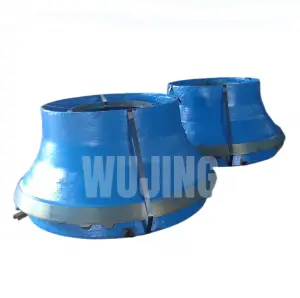
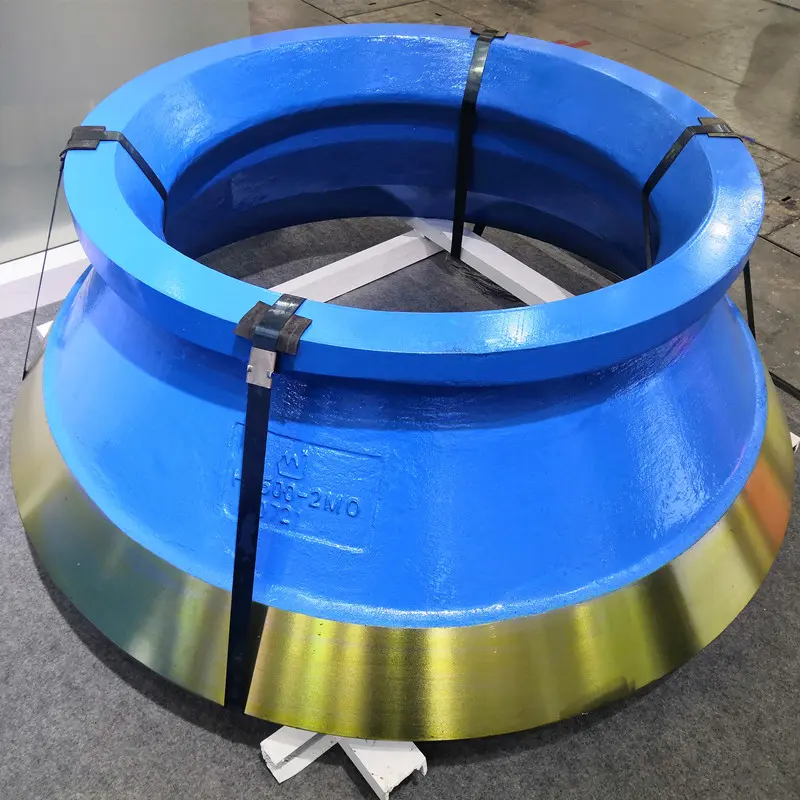
For operators of mines and quarries worldwide, stable operation of cone crushers is critical to maintaining production line efficiency. As core wear parts of cone crushers, bowl liners and mantles directly influence operational costs and productivity. Especially in bulk purchasing, a single wrong choice can lead to massive financial losses and prolonged downtime.
Therefore, conducting a comprehensive, detailed inspection before signing contracts is essential. It ensures you receive value-for-money products and is a key step in mitigating future risks.
Technical Specifications & Material Compatibility
This is the first evaluation step to confirm products are tailored to your specific conditions.
Material-Working Condition Matching
Inspection Points: Does the material recommended by the supplier (e.g., high manganese steel, alloy steel, high chromium cast iron) match the hardness and abrasiveness of your crushed materials (e.g., granite, basalt, iron ore)?
Why It Matters: Different ore characteristics require wear-resistant materials with distinct properties. For example, high manganese steel excels in work-hardening under high-impact conditions, while high chromium cast iron offers superior abrasion resistance in high-stress abrasive environments. A professional supplier should provide material recommendations based on your specific conditions, not a one-size-fits-all solution.
Drawing & Dimensional Accuracy
Inspection Points: Can the supplier provide detailed product drawings for verification? For non-standard or replacement parts, how do they confirm dimensions? Do they support reverse engineering services?
Why It Matters: Even minor dimensional deviations can cause installation difficulties, abnormal vibration during operation, or damage to the main crusher unit. Ensuring the supplier can accurately replicate dimensions via drawings or samples is a prerequisite for “plug-and-play” installation.
Casting Process & Internal Quality
Inspection Points: What casting process does the supplier use? How do they control internal casting defects such as porosity, slag inclusions, and shrinkage porosity?
Why It Matters: Internal casting quality directly determines structural strength and service life. Advanced casting processes and strict process control guarantee defect-free, highly reliable products.
Quality Control & Production Capability
This section verifies whether the supplier can deliver on quality promises with consistent, high-quality production.
Production Scale & Equipment Capacity
Inspection Points: What is the factory’s scale? How many melting furnaces, heat treatment furnaces, and machining equipment does it possess? What are the monthly and annual production capacities?
Why It Matters: Strong production capabilities are the foundation for on-time delivery of large-volume orders. For example, enterprises like Wujing Foundry, with a 150,000 m² plant, 5 factories, and over 800 employees, achieve monthly production exceeding 3,000 tons and annual output of 45,000 tons. Equipped with various large-scale professional equipment, they provide solid support for accepting and completing large custom orders on schedule.
Quality Inspection Processes & Documentation
Inspection Points: What key QC checkpoints are in place from raw material receipt to finished goods delivery? Can they provide spectral analysis reports for each heat and heat treatment curves? Is hardness testing performed on 100% of products or via random sampling?
Why It Matters: A transparent, traceable quality control system is the cornerstone of product stability. Requesting detailed inspection reports is the most direct way to verify whether quality commitments are fulfilled.
Third-Party Inspection & Factory Audit
Inspection Points: Does the supplier accept pre-shipment inspections by third-party agencies such as SGS or BV? Do they welcome online or on-site factory audits by customers?
Why It Matters: This is a litmus test of supplier confidence. Factories willing to undergo rigorous audits typically have greater confidence in their management, production processes, and quality control.
Commercial Terms & After-Sales Support
Clear commercial terms and reliable after-sales service are the lubricant and safety net for long-term cooperation.
Packaging & Logistics Solutions
Inspection Points: What packaging is used for heavy castings during sea transport to prevent rust and collision? Are fumigated wooden boxes or steel pallets employed? Are additional protective measures such as anti-rust oil applied?
Why It Matters: Professional packaging ensures high-value cargo arrives intact after long-distance transport, avoiding disputes and project delays caused by shipping damage.
Quality Warranty & Claim Policy
Inspection Points: What is the product’s quality warranty period? Under normal operating conditions, what is the claim process if service life fails to meet agreed standards?
Why It Matters: This is your most important rights protection. A responsible supplier provides clear, fair warranty and claim terms, demonstrating confidence in product quality and sincerity toward customers.
After-Sales Service & Technical Support
Inspection Points: Does the supplier offer installation guidance or on-site technical support? Can they provide timely technical responses when equipment operation issues arise?
Why It Matters: Excellent after-sales service not only resolves unexpected problems but also helps optimize equipment operation, extend component life, and achieve higher returns on investment through professional advice.
By systematically inspecting the above nine aspects, you can comprehensively evaluate potential suppliers and make informed bulk purchasing decisions to safeguard your mining operations.
Post time: Jul-09-2026