
In construction waste recycling projects, crushing equipment is at the core of operations. Sustained, efficient equipment performance relies entirely on the quality of wear-resistant spare parts.
Unlike natural ore processing, construction waste consists of complex, mixed materials including reinforced concrete, wood, plastic, and more. This places far stricter demands on the wear resistance and impact resistance of crusher parts.
This guide provides professional part selection strategies for procurement managers at global construction waste recycling enterprises, helping you make informed decisions in a competitive market and effectively control operating costs.
I. Understand the Unique Challenges of Construction Waste Crushing
Before purchasing, you must fully understand the working conditions of construction waste crushing, as these directly determine your parts selection direction.
Complex and variable material composition: Materials include concrete blocks, bricks and stones, plus high-hardness, high-toughness steel bars. Parts must be not only wear-resistant but also highly impact-resistant to avoid breakage when crushing reinforced materials.
Discontinuous impact loading: Unlike uniform ore feeding, construction waste feeding is often uneven, exposing crushers to intermittent heavy impact forces.
Diverse wear mechanisms: Parts suffer simultaneous abrasive wear (from sand and stone), impact wear (from steel bar collisions), and fatigue wear.
Therefore, the core purchasing goal is to find materials that achieve an optimal balance between wear resistance and impact resistance.
II. Material Selection Strategies for Core Wear-Resistant Parts
Material selection should be tailored to the specific conditions of construction waste crushing and the type of crushing equipment.
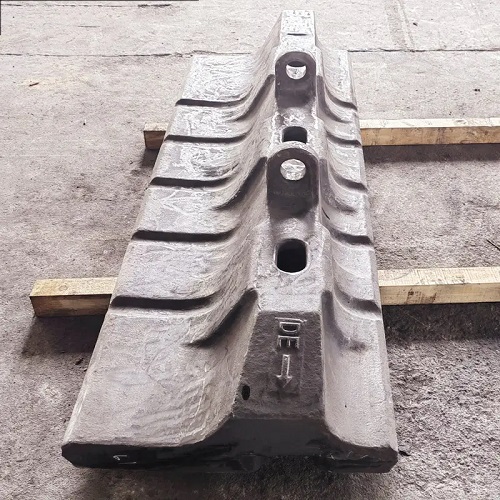
1. Jaw Crusher Parts: Jaw Plates
Jaw plates are critical for primary crushing and directly withstand impacts from large materials.
Preferred material: High Manganese Steel
Reason: High manganese steel features a unique work-hardening characteristic. Under strong impact, its surface hardness increases sharply to form a hard wear-resistant layer, while the core retains high toughness to absorb impact energy and prevent fracture.
This makes it ideal for handling reinforced concrete mixtures in construction waste.
2. Impact Crusher Parts: Blow Bars
Blow bars rotate at high speed to strike materials and are among the fastest-wearing components.
Preferred material: High Chrome Iron
Reason: High chrome iron contains a large number of hard chromium carbides, delivering far higher wear resistance than manganese steel. It excels in applications dominated by abrasive wear.
For pre-crushed construction waste with low steel content, high chrome iron blow bars provide significantly longer service life.
Some high-end models use an alloy steel matrix embedded with tungsten carbide to achieve a superior balance between wear resistance and toughness.
3. Cone Crusher Parts: Bowl Liner & Mantle
Cone crushers are typically used for secondary or tertiary fine crushing.
Preferred materials: High Manganese Steel or High-Performance Alloy Steel
Reason: Materials are compressed and bent between the bowl liner and mantle. The work-hardening behavior of high manganese steel performs well in this environment.
For extremely high-impact conditions, specially heat-treated alloy steels deliver excellent overall performance.
III. Key Dimensions for Supplier Evaluation
After selecting suitable materials, choosing a reliable supplier is equally important. Evaluate potential partners using these criteria:
1. Material Certifications & Test Reports
Require suppliers to provide authoritative third-party material certificates and mechanical performance test reports (including hardness and impact toughness tests). These are the most direct proof of material compliance.
2. Casting Process & Quality Control
Review the supplier’s casting processes (such as lost foam casting, sand casting) and heat treatment capabilities. Advanced processes and strict quality control ensure parts are free of internal defects and deliver stable performance.
A professional foundry with decades of industry experience is usually more trustworthy.
3. Industry Experience & Case References
Verify whether the supplier has a proven track record serving the construction waste recycling industry. Experienced suppliers can share successful case studies under different working conditions and provide targeted selection advice.
4. Customization Capability
Different crushers and working conditions may require non-standard or modified parts. The ability to produce customized products based on customer drawings or samples is a key measure of technical strength.
5. After-Sales Service & Technical Support
Reliable suppliers offer more than just products; they provide installation guidance, wear analysis, and technical support to help customers optimize usage and extend part service life.
Conclusion
By following this guide, construction waste recycling enterprises can systematically evaluate and select the most suitable wear-resistant parts, ensuring efficient equipment operation while maximizing return on investment.
Post time: Jun-24-2026