
Potash is the cornerstone of the global fertilizer industry, with approximately 95% of global potash production ultimately used to manufacture Muriate of Potash (MOP) and Sulfate of Potash (SOP). From deep deposits in the Saskatchewan Basin, Canada, to evaporite mines in the Sakon Nakhon Basin, Laos, raw potash ores (primarily sylvite and carnallite) generally feature low Mohs hardness (1.5–2), high water solubility, and strong hygroscopicity. These unique physical properties determine that crusher selection logic in potash processing is vastly different from that in limestone or metal mining. From an engineering perspective, this article analyzes how crushing equipment helps potash fertilizer producers balance production capacity, particle size control, and operating costs.
1. Raw Ore Preprocessing: Primary Liberation with Jaw Crushers & Cone Crushers
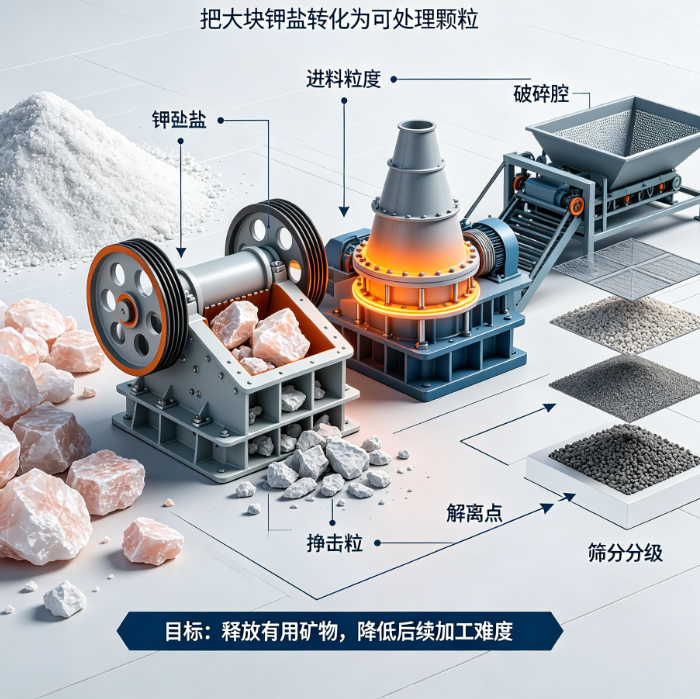
In the mineral processing flow of solid potash ores, crushing acts as a critical bridge between mining and flotation. Taking typical sylvite as an example, large raw ores extracted underground first enter a jaw crusher for primary crushing, followed by secondary crushing to reduce material particle size to the 5–15 mm range. This particle size window is critical: oversized particles lead to insufficient mineral liberation and higher flotation tailing grades, while overly fine particles generate excessive slime and increase desliming loads.
At this stage, cone crushers are commonly deployed for secondary crushing. Supported by a hydraulic discharge adjustment system, operators can precisely control discharge gradation, laying the foundation for efficient subsequent liberation in rod mills. However, the deliquescent nature of potash easily causes material adhesion within crushing chambers. Modern potash crushing stations are therefore typically equipped with pre-screening equipment, dehumidification buffer bins, and high-manganese steel liners to effectively alleviate chamber clogging and ensure continuous system operation.
2. Fine Crushing & Over-Crushing Control: Process Advantages of Roll Crushers
Responding to potash’s high brittleness and strict over-crushing rate control requirements, roll crushers are increasingly widely adopted in potash fertilizer plants worldwide. Unlike impact crushing principles, roll crushers use dual shearing and compression forces to steadily reduce wet material size from 12–19 mm to 1–2 mm. For instance, North America’s Intrepid Potash plant uses high-precision roll crushers to process compacted flake potash, with roll gap adjustment accuracy reaching one-thousandth of an inch, significantly improving conversion efficiency from compacted flakes to finished products.
This low over-crushing characteristic is decisive for maintaining flotation recovery rates and reducing energy consumption. For buyers, when evaluating such equipment, besides single-machine production capacity, greater attention should be paid to roll shell materials — high-quality alloy steel or specially heat-treated medium-chromium iron roll shells greatly extend service life in chloride-corrosive environments.
3. Caking Treatment in Fertilizer Production: Vertical Crushers & Chain Crushers
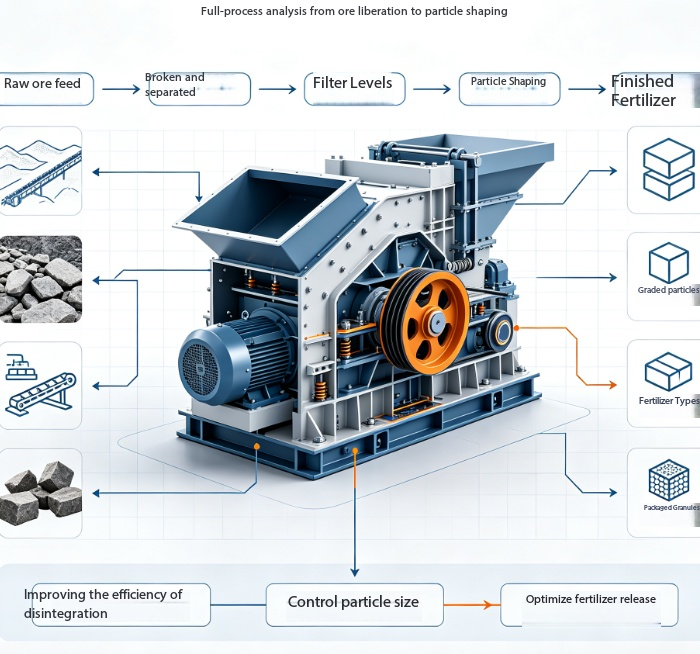
Leaving mineral processing plants and entering compound fertilizer and bulk blending (BB) fertilizer workshops, crusher functions shift from mineral liberation to caking reduction. Basic raw materials such as urea and potassium chloride easily form hard agglomerates of 100–500 mm under high-temperature and high-humidity conditions. Direct entry into batching bins causes belt jams and inaccurate metering.
Here, vertical crushers and chain crushers become core equipment. Vertical crushers feature a closed structure and controllable dust, making them ideal for fine crushing dry crystalline potash. They uniformly control discharge fineness below 3 mm, ensuring stable formulation accuracy in electronic metering scales. Given the weak corrosiveness of fertilizer materials containing chloride and ammonium ions, equipment contact components usually adopt stainless steel cladding or high-chromium iron wear parts to prevent rust contamination of finished fertilizers.
4. Compaction Granulation Closed Loop: Particle Shaping with Cage Mills
Modern granular potash fertilizers mostly adopt the compaction granulation process: fine potash powder is compacted into flakes by roll presses, then crushed and multi-stage screened to form final products. Particle size distribution at this stage directly determines finished product anti-caking performance and nutrient uniformity. Cage-Paktor cage mills or small roll crushers play a key role here, responsible for “shaping” compacted flakes into qualified particle sizes. Oversized coarse flakes are recrushed, while fine powder returns to roll presses. This closed-circuit circulation system requires extremely high operational stability from crushing equipment; any fluctuation directly impacts finished bulk density (typically 1.90–1.95 g/cm³) and market pricing.
5. Synergistic Effects of Wear-Resistant Spare Parts & Auxiliary Systems
In potash and fertilizer production lines, standalone crushing equipment cannot operate efficiently. Vibrating screens form closed circuits with crushers to intercept off-spec particles; belt conveyors connect mining areas and grinding workshops; vibrating feeders ensure uniform feeding of sticky and wet raw ore into crushing chambers to avoid peak impacts.
Notably, despite potash’s low hardness, associated quartz impurities and humid environments pose severe challenges to crusher wear parts. Combined applications of high-chromium iron, medium-chromium iron, modified high-manganese steel, and various alloy steels are key to ensuring toughness while extending maintenance intervals. For overseas buyers, casting quality, delivery cycles, and material analysis reports (such as metallographic structure testing) of wear parts often influence total project Total Cost of Ownership (TCO) more than host equipment unit prices.
Conclusion
In the potash and fertilizer industry, crushers are not merely size-reduction tools but core hubs for controlling production costs and improving product quality. From controlling over-crushing rates to enhance recovery rates, to preventing caking and ensuring batching precision, every process detail tests equipment manufacturers’ technical expertise. For buyers seeking long-term stable supply, partnering with suppliers offering full-process crushing solutions and high-quality wear parts is essential to securing 3–5 years of operational efficiency and profitability.
Post time: Aug-04-2026