
An 18% Cheaper Bar That Cost Eleven Days
A demolition recycling contractor in the English Midlands ran a 1,060 mm impact crusher on mixed rubble. The buyer switched from a martensitic bar to a high-chrome set quoted 18% cheaper, saving GBP 1,900 per set.
Three weeks in, one bar met rebar hidden in a slab. Instead of denting, it fractured; fragments passed the apron and scored the rotor body and one bearing housing.
The rotor rebuild came to GBP 14,600, and eleven days of lost throughput at GBP 4,700 per day ran to about GBP 52,000, roughly thirty-three times the saving.
The Material Options and Where Each One Wins
Four families cover almost every duty, and each wins on a different feed. Choosing on price alone is how a circuit inherits a rotor repair.
Martensitic steel is the safe default for contaminated and reinforced feed where tramp steel is routine: it deforms before it cracks, protecting everything downstream of the rotor.
High chrome wins on clean abrasive feed such as river gravel or silica above 4%, where wear life dominates. Martensitic with ceramic insert suits high-value abrasive duties, giving two to three times the life of plain martensitic.
Manganese still earns its place where impact loading is severe and work hardening helps, in primary duty on hard blocky rock. Specifying any of these starts with impact crusher blow bars matched to your real feed.
Hardness Against Fracture Toughness, in Numbers
Metallurgy is a trade, not a ranking: hardness buys abrasion resistance, toughness buys fracture resistance. No alloy maximises both.
Martensitic bar runs 500 to 550 HB with Charpy energy of 30 to 50 J at room temperature; high chrome reaches 600 to 650 HB but falls to 5 to 10 J, about a fifth of that.
Set a floor, not a hope: with rebar in the feed, demand at least 25 J at 20 degrees Celsius; on clean abrasive stone, 600 HB and above. Where impact loading is total, the same reasoning governs anvils for shredder crushers.
Matching the Set by Weight and Keeping the Rotor Balanced
A rotor is a precision assembly. Every bar must be weighed and fitted as a balanced pair opposite its match, not wherever it lands.
Hold bars within 1% of nominal, about 0.5 kg on a 50 kg bar. An unbalance of just 200 grams at 500 mm radius generates roughly 395 N of centrifugal force at 600 rpm.
The damage is slow and expensive: since bearing life varies with the cube of load, a 20% load rise cuts bearing life by about 40%, frame welds crack, and vibration passes 7 mm/s RMS. The same discipline governs every rotating casting, down to a socket liner and eccentric bushing.
The Turning and Rotation Sequence That Holds the Profile
Bars wear unevenly, so rotation is what keeps the crushing profile square and the product curve stable. Skip it and gradation drifts before the bars are finished.
Work to measured wear, never a calendar: weigh or profile the set every 40 to 60 hours, turn end for end at about 50% of usable mass, and replace below 60% of new weight.
Never mix a half-worn bar with a new one: a mass spread above 5% across the set unbalances the rotor and puts product out of spec. Change the full set and log tonnes at each change.
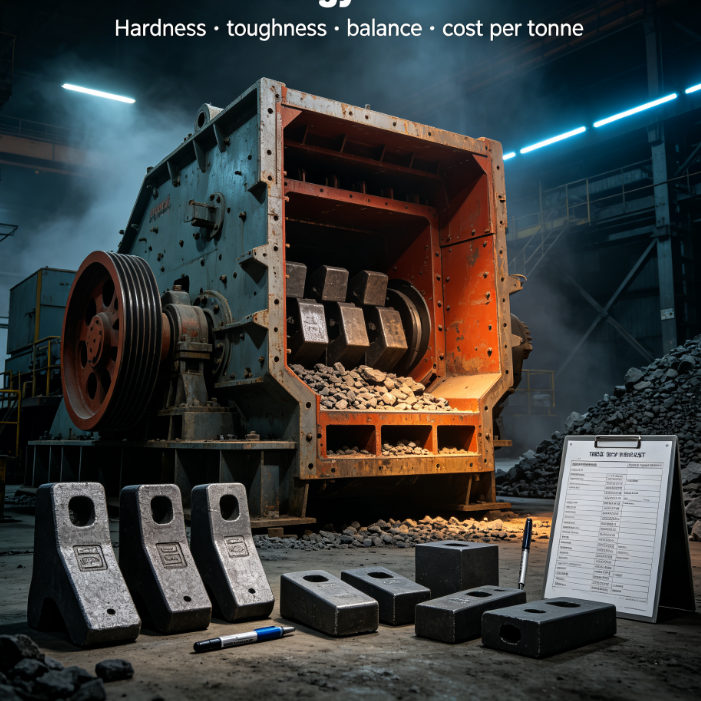
Rotor Speed and Reduction Ratio Set Both Wear and Risk
Speed is the sharpest lever on the panel and the most abused. Raising tip speed lifts throughput, but wear climbs far faster than output, and so does breakage risk.
Most horizontal-shaft impactors run at 30 to 45 m/s tip speed, where a 10% increase raises bar wear by 20% to 30% and sharply lifts the chance of a bar failing on tramp steel.
Reduction ratio behaves the same way: beyond about 15 to 1 in hard feed, fines and their wear both multiply. Take reduction in stages.
A Cost-Per-Tonne Calculation with Worked Numbers
Take a plant crushing 150,000 tonnes a year, a four-bar set, changeout labour of 6 hours at USD 65 and downtime at USD 900 per hour.
Option A, the cheap high-chrome set at USD 1,680, lasts 42,000 tonnes, so 3.6 sets a year: parts USD 6,048, labour USD 1,404, downtime USD 12,960. Total USD 20,412, or USD 0.136 per tonne.
Option B, a martensitic set at USD 2,160, is dearer by 29% but lasts 60,000 tonnes, so 2.5 sets: parts USD 5,400, labour USD 975, downtime USD 9,000. Total USD 15,375, or USD 0.103 per tonne.
The dearer bar saves about USD 5,000 a year and one full changeout, before the breakage risk option A carries.
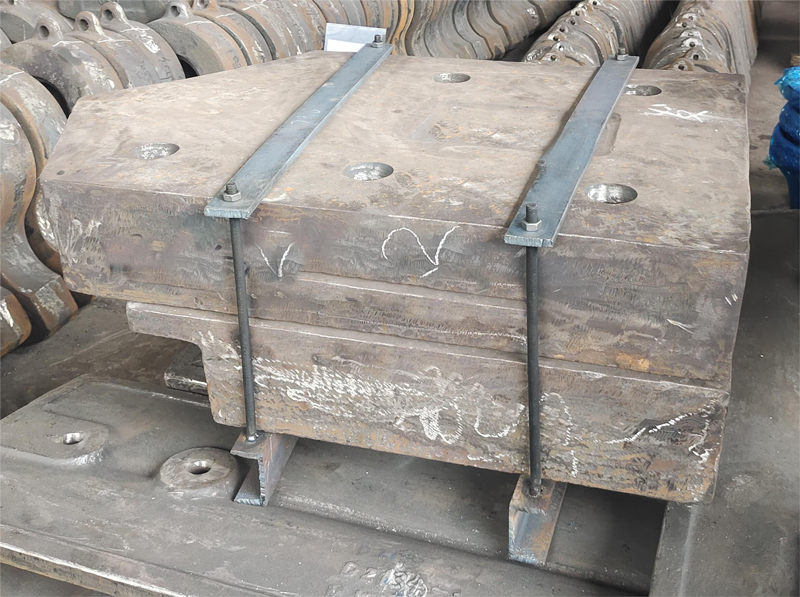
The Questions to Put to a Foundry
Approve an alloy against answers, not a datasheet: ask for the Charpy value at 20 and minus 10 degrees and for through-hardness 25 mm below the working face, not just at the surface.
Ask what weight tolerance it holds across a set, what failure mode the alloy shows on rebar feed, and whether a heat number traces to the charge and heat treatment chart. A foundry casting crusher liners for shredder metal usually has that discipline.
Finally, ask for a trial set with a wear-life figure in tonnes and a joint review at first change. A supplier quoting only hardness sells you half the decision.
The Bottom Line
Blow bar selection is an engineering decision with a price tag attached. Match the alloy to the feed first, hold 25 J of toughness where rebar is present, and weigh every bar so the rotor stays balanced.
Then judge on cost per tonne, including labour and downtime, not invoice price. On a 150,000 tonne plant that arithmetic is worth about USD 5,000 a year and one less rotor at risk.
Related Pages
Jaw Plate Pricing Guide: Cost Analysis by Material Grade
Mantle vs Bowl Liner: Key Differences Every Aggregate Buyer Must Know
OEM vs Aftermarket Crusher Wear Parts
Post time: Sep-16-2026