
A cement plant buyer stands on the foundry floor three days before a kiln shutdown, watching a manganese steel casting cool on the shakeout grid because the liner in his truck decides whether the outage finishes on schedule. He came because a witnessed inspection here costs a fraction of a failed installation.
Most trading offices cannot offer this access, while a real foundry lets the buyer stand at the pour and read the records himself.
When should a buyer nominate the casting stages he wants to witness?
The sequence follows the natural life of the casting, from pattern to marking, and a buyer should nominate each point before the pattern is cut. Pattern and tooling check comes first, then melt and chemistry with heat number traceability, pouring temperature and gating, shakeout and riser removal, heat treatment chart review for austenitising and water quench, proof machining, dimensional layout of fitting surfaces, hardness mapping, a short NDT check by section thickness, and final visual and marking.
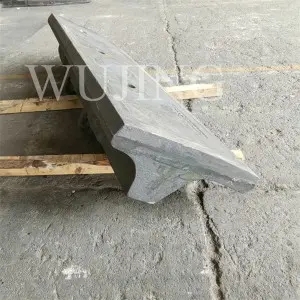
The EGL SAG mill lining system runs at 6.7 m diameter by 3.5 m effective grinding length, and its liners are the heaviest wear castings most buyers will witness.
liners support for EGL SAG mill lining system 6.7 m x 3.5 m
These liner support castings are ordered to the mill drawing and proof-machined on the bolt holes before they leave the foundry. A buyer who witnesses the dimensional layout avoids grinding a 6.7 m liner on site.
Nominate the pour and the heat treatment chart review as the two stages you will never waive.
What must the buyer demand in writing at each stage?
Each stage needs a one-page acceptance record signed by the foundry inspector and the buyer’s representative. At the melt stage that means the chemistry certificate tied to a single heat number.
Austenitising and water quench is the standard route for manganese steel wear parts, and the chart must show the hold temperature and the quench start time.
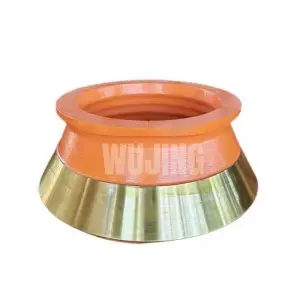
Mantle and bowl liner support castings for HP and GP cones are ordered against the machine model, so the written spec must name the exact crusher before any pattern is cut.
mantle and bowl liner support for HP and GP cone crushers
These cone crusher wear parts are proof-machined on the seating faces so they sit true against the bowl and the head. A buyer who watches the layout protects himself from a mantle that rocks under load.
Request a signed MPI or ultrasonic report mapped to each heat number before you pay the balance.
The chemistry certificate tied to a single heat number at the melt stage.
The heat treatment chart showing the austenitise hold and quench start.
The dimensional layout record of the critical fitting surfaces.
How much notice keeps the foundry’s production flowing?
A witness at the pour needs a notice period of about five working days so the furnace schedule can be planned around the buyer’s visit.
The support parts for S4800 and CS440 crushers use high manganese steel tuned for impact wear. Booking the witness early keeps your castings in the queue and supports any later foundry audit.
high manganese steel wear resistant support parts for S4800/CS440 and H4800/CH440
These support castings hold the wear liners in place, so their dimensional accuracy matters as much as the liners. The H4800 and CH440 variants follow the same routine.
Build a remote evidence pack with time-stamped photos and a short video when travel is impossible.
Can remote evidence packs replace a physical foundry visit?
A remote pack is not a weaker option when built correctly, it is a different channel for the same evidence. The foundry sends time-stamped photos of the pattern, the heat number stamp and the heat treatment chart as a signed PDF.
Hardness mapping is read across the wearing face, not at a single corner, and the pack should show the probe points numbered on the casting. For sections under 40 mm the NDT uses magnetic particle inspection, while ultrasonic testing suits 40 mm and above.
Time-stamped photos of pattern, gating and the heat number stamp before the box closes.
A short video of the pour showing the temperature gauge and ladle sequence.
Signed heat treatment chart with austenitise hold and quench start recorded.
Confirm the riser removal and shakeout inspection in writing before the pattern is poured, even on a remote job.
What does a witnessed inspection cost against a failed kiln outage?
A witnessed stage inspection typically adds only two to four percent to the unit price of a wear casting.
A liner that fails inside the mill during a scheduled shutdown can stop the whole cement line for days, and one day of lost production during a forced outage commonly runs into five figures.
Skipping the heat treatment chart review risks accepting a casting with the wrong austenite structure, which wears unevenly and can crack under impact.
What happens when a stage is failed and recorded?
A failed stage should trigger a written non-conformance and a hold on the next operation, not a quiet re-melt. The buyer chooses rework, replacement, or acceptance with a documented concession.
Ignoring the dimensional layout of fitting surfaces forces on-site grinding that no shutdown window allows, so a failed layout must be corrected at the foundry.
The foundry issues a non-conformance report referencing the heat number and stage.
The buyer decides rework, replacement, or concession within the agreed window.
The corrected casting is re-inspected at the same stage before release.
What should a buyer do before he releases the next order?
Before the next purchase order, send the foundry a one-page witness plan that names the stages, the notice periods, and the evidence pack format you expect.
Keep the pattern ownership clear so reorders stay accurate, and treat the witnessed castings as the ones that arrive ready to install.
Related Pages
Jaw Plate Pricing Guide: Cost Analysis by Material Grade
Mantle vs Bowl Liner: Key Differences Every Aggregate Buyer Must Know
OEM vs Aftermarket Crusher Wear Parts
Post time: Oct-27-2026