
The Shipment That Turned a Planned Outage Into a Crisis
A cement plant scheduled a mill relining to coincide with its kiln outage, confirmed delivery eighteen weeks ahead and booked the installation contractor against a fixed window. The liners arrived on time. Eleven of them were bent around bolt-hole lands, six had visible cracks, and none were identified in installation order. Sorting, straightening and re-manufacturing consumed nine days of a fourteen day outage, and the cost of idle contractor labour plus lost clinker production exceeded the value of the entire casting shipment several times over. The castings themselves were metallurgically perfect. What failed was everything that happened after they left the foundry floor, and in this business transit damage is not a quality complaint, it is a schedule risk measured in tonnes per day.
Castings Are Not Palletised Goods
The first thing to accept is that heavy wear castings behave nothing like ordinary freight. They are dense, often irregular in shape, brittle in thin sections and heavy enough that any movement inside a container generates enormous force. A manganese mantles or mill liner section weighing over a tonne resting against another casting will crack it during a single hard brake application. Damage of this kind is almost never caused by a dramatic accident; it is caused by insufficient restraint combined with thousands of small movements accumulated over several weeks at sea. Packaging therefore has to restrain differential movement, not merely contain weight.
Contact Points Decide Whether Parts Arrive Square
Every casting needs deliberate support at points chosen to carry load through its strongest sections, with separation between all contact surfaces. Nesting liners inside each other without dunnage is the single most common cause of bent bolt lands and cracked ribs. Where lashing passes over a sharp edge it will either cut itself or deform the casting underneath, and both outcomes are discovered at the destination rather than at the factory. Require edge protection at every lashing point and ask who designed the restraint scheme, because lashing designed by riggers rather than by the foundry’s own engineers is a recurring source of failure.
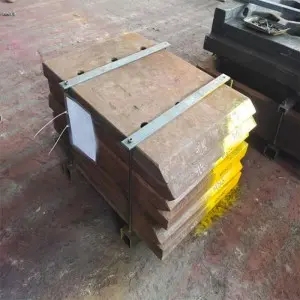
Floor Loading and the Container Decision
Containerised shipping is economical but it imposes floor loading limits that heavy castings exceed quickly. Concentrated load spread over a small footprint can deform the container floor and, in the worst case, drop through it during handling. Beyond a certain unit weight, breakbulk or flat rack becomes the correct answer even at higher freight cost. Compare options on total landed cost including risk rather than on freight rate alone, because one damaged lifting event erases several years of freight savings on standard containers. Large components such as this SAG mill lining system liner set should always be planned with weight spreading explicitly.
Heavier Families Need Their Own Loading Plan
Different casting families ship differently, and a single plant nameplate does not make them interchangeable. Ball mill liners are smaller and more numerous, which favours containerised shipment with careful stacking. Shredder and metal crusher liners often combine heavy sections with machined faces that must not be marked. Ask for a loading plan per family rather than a generic packing statement, and check that plan against the actual piece weights rather than against nominal catalogue values. A family such as this ball mill liner range is well suited to that kind of documented approach.
Smooth-Faced Components Need Surface Protection
Machined or semi-machined surfaces present their own trouble. Gouges on a seating face can affect fit to the mill shell, and small damage that looks cosmetic often becomes a backing or alignment problem during installation. Liners destined for shredder duty frequently combine wear surfaces with precision faces. Specify faces that must remain undamaged and require individual protection on those surfaces, because the installer will reject anything that does not seat correctly and the cost argument will not change his mind. Ranges such as these metal shredder and crusher liners deserve exactly that specification.
Sequence Is a Specification, Not a Courtesy
Mill relining proceeds in a defined sequence and stops entirely if the next section is not available. A shipment delivered complete but unordered wastes paid contractor hours in the yard sorting through a stack weighing several tonnes. Every piece should carry a visible mark corresponding to its position, and the packing list must list items in installation order rather than in production order. Insist on this at order placement, because remarking and resequencing castings at site is one of the most expensive low-value tasks in any outage. Mantle and concave deliveries for crushers should follow the same logic, as with this pairing of mantle and bowl liner for cone crushers shipped as identified sets.
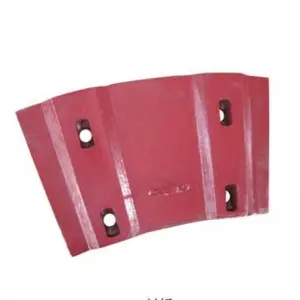
Small Parts Disappear First
Alongside the heavy items sits a collection of smaller components whose loss is disproportionately disruptive. Bushings, socket liners and eccentric components are compact enough to be mislaid and important enough to stop everything. These should be boxed, sealed, individually labelled and listed separately on the packing list rather than loaded loose. Require one line per piece rather than a consolidated weight entry, because consolidated entries make shortage claims impossible to prove later. Items like this socket liner and eccentric bushing are typical candidates for a carton that nobody can find on site.
Corrosion and Documentation Travel Together
Long sea voyages and humid destinations produce surface rust that alarms inspectors even when it is harmless, and damp packaging accelerates it further. Ask for dry packing, desiccant where appropriate and clear advice on whether protective coating should be removed before installation. Agree what surface condition is acceptable on arrival in writing, because otherwise the first inspection stops for an argument nobody can settle objectively. Then require photographs of the finished load and a piece-marked packing list before the container is sealed.
Inspect Before Signing Anything
Receiving discipline closes the loop. Check piece count against the packing list, photograph damage before unloading begins, note exceptions on the delivery document rather than afterwards, and record piece marks against the installation sequence immediately. Signing a clean delivery note converts recoverable transit damage into an unrecoverable cost, and it takes thirty seconds of attention to prevent. Build these steps into the outage plan in advance so that whoever is on shift at six in the morning knows what he is required to do.
Related Pages
Jaw Plate Pricing Guide: Cost Analysis by Material Grade and Specification
Mantle vs Bowl Liner: Key Differences Every Aggregate Parts Buyer Must Know
OEM vs Aftermarket Crusher Wear Parts: Which Offers Better Value
Post time: Sep-29-2026