
A Cement Plant Waited Fourteen Weeks for a Copy That Did Not Fit
A cement plant in the Middle East needed a replacement liner for a crusher whose original equipment supplier had discontinued support on an ageing machine. The plant shipped a worn sample to a foundry and waited. The first casting arrived fourteen weeks later and would not seat, because the foundry had copied the worn sample as found, including the wear loss, and had no drawing of the original geometry to reconstruct it. A second round added another ten weeks. The plant had treated reverse engineering as a photocopy when it is really a reconstruction, and the downtime cost dwarfed the casting price several times over.
A Worn Sample Is a Damaged Reference, Not a Drawing
The fundamental point buyers miss is that a worn part has lost material in exactly the places that matter for fit. Bearing faces, seating surfaces and bolt lands are precisely the areas that wear and precisely the areas that control the fit. Send the least worn sample available, and send more than one so the foundry can reconstruct the original profile from the least affected sections. Photograph the samples in the installed position before removal and mark which face is the working face and which is the mounting face. An unmarked sample forces the foundry to guess orientation, and a guess in casting becomes a scrapped pattern.
Measure the Machine, Not Only the Part
The reliable reference is the machine the part fits, not the part itself. Provide the crusher or mill model, the serial number, the chamber configuration and any available original drawing, even an outdated one. Measure the seating face on the machine directly with a tape and a level and record it. Confirm the number of bolt holes, the pitch circle and the bolt grade — these are the three details most often wrong on a first-off reverse engineered casting. Ask the foundry to send a dimensional drawing for approval before any pattern is cut, because correcting a drawing costs an email and correcting a pattern costs weeks.
Shrinkage Allowance and the Pattern Question
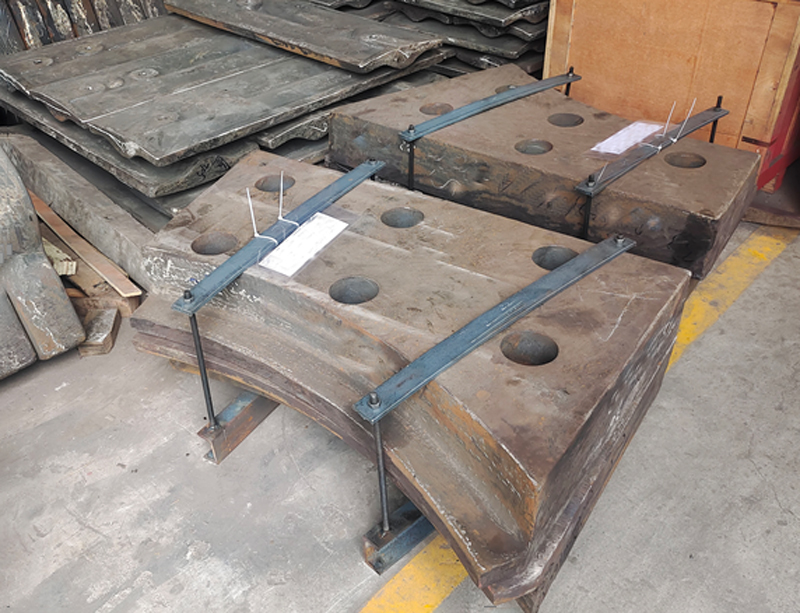
Steel castings shrink, and the pattern must be made oversize by a shrinkage allowance specific to the alloy and the section thickness. A foundry that applies a generic allowance across a thick-section manganese casting produces parts that machine out undersize. Ask which allowance is being used and why, and confirm it is adjusted for the heavy sections in your part. Where a seating face is machined afterwards, confirm the machining allowance is sufficient on the drawing. For a impact crusher blow bar, the rotor slot fit and the mass balance depend on this being right, and an error here is a safety issue, not just a delay.
Material Identification From a Sample
Reverse engineering also means identifying what the original part was made of, and a spark test is not identification. Require a full spectroscopic analysis of the sample and a hardness survey across the section. Then specify the target alloy against the application, not merely against the sample: if the original part wore out early, copying its chemistry copies the problem. Upgrading the alloy without telling the foundry that mass and balance will change is another common error. Confirm the part weight tolerance explicitly when the alloy changes, especially for rotating parts and paired sets.
First Article Inspection and the Trial Fit
The first casting from a new pattern should never go straight into service. Require a first article with a full dimensional report tied to the approved drawing, and perform a dry trial fit on the machine before the part is put into production. Record the trial fit with photographs and sign it off. Skipping the dry fit to save a shift is the decision that turns a two-week job into a three-month one. The same rule applies to a shredder or metal crusher liner, where the profile is complex and a dry fit is the only honest check. Keep the approved drawing and the first article report as the master reference for every repeat order, so the second order does not become another development project.
Pattern Ownership, Storage and Repeat Orders
Patterns cost money and ownership is rarely discussed until there is a dispute. State in the contract who owns the pattern, where it is stored and how long it will be retained. Agree the storage period and the condition for reactivation, because wooden patterns left in a humid store warp and silently change the casting geometry. Ask for a photograph of the pattern before each repeat production run. For larger assemblies, a mantle and bowl liner set should be ordered as a matched pair from patterns held together, since mixing patterns across suppliers produces a chamber profile nobody designed.
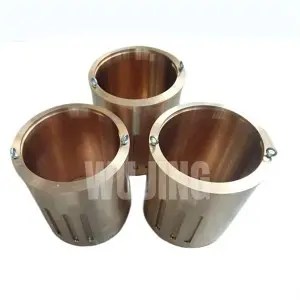
Adjacent parts benefit from the same file. A socket liner and eccentric bushing ordered against a reverse engineered drawing held on file can be reordered in weeks rather than rediscovered over months. Build the drawing library once and every future order gets faster. Complex chamber geometries are worth scanning in three dimensions if the part is likely to repeat.
The Bottom Line
Reconstruct, do not photocopy: send the least worn samples, measure the machine, approve a drawing before the pattern is cut, and dry-fit the first article. Every week saved by skipping the drawing approval is paid back several times over in a casting that does not fit.
Related Pages
Jaw Plate Pricing Guide: Cost Analysis by Material Grade
Mantle vs Bowl Liner: Key Differences Every Aggregate Parts Buyer Must Know
OEM vs Aftermarket Crusher Wear Parts: Which Offers Better Value
Post time: Sep-18-2026