
The Shredder That Lost Money on Every Tonne It Processed
A scrap recycling operation bought a shredder wear parts package on unit price and then spent the following year confused about why the line was still unprofitable at good throughput. The hammers were being replaced on a cycle set by breakage rather than by wear, the grate was restricting output for six weeks of every campaign, and the reject door was being rebuilt on site twice a year.
Every one of those three problems is a specification problem, and all three are visible before the first order is placed. Shredder wear parts behave differently from crusher wear parts, and buyers who apply crusher logic to a shredder end up optimising the cheapest item while the expensive one sets the cost.
Why Shredder Duty Is Its Own Category
A crusher works mostly against compression and abrasion. A shredder works against impact, and the impact is often from material the machine was never meant to see. Tramp steel, engine blocks, sealed containers and unknown inclusions arrive with the feed, and the wear parts have to survive them rather than merely resist abrasion.
That single fact reorganises the whole specification. Hardness, which dominates crusher wear thinking, is a secondary property here. Toughness and crack resistance come first, because the failure mode that costs money is a broken hammer, not a worn one, and a broken hammer takes out the rotor and the grate with it.
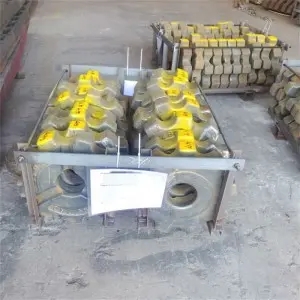
Hammers are the clearest case. A shredder hammer for metal crushers should be specified on impact toughness and on the rotor balance consequence of a failure, not on surface hardness alone. Ask what happens when one breaks, because that answer is the real specification.
Hammers: Set, Balance and Rotation
The first operational rule is that hammers are changed as matched sets by weight, not individually as they wear. An unbalanced rotor destroys bearings and shaft, and the cost of that repair dwarfs the hammer set it was meant to save. Buyers should insist on weight-matched sets with the weight recorded per hammer and per rotor position.
The second rule is that hammer wear is not uniform around the rotor. Feed enters at a particular point and the wear distribution follows it, which is why a defined rotation schedule, moving hammers between positions at a set interval, extends set life materially at no cost. A written rotation schedule is the cheapest life extension available in a shredder, and most operations do not have one.
Third, the shape of the wear face tells the buyer what is happening. Rounded, polished wear is normal abrasion. Chipped edges point to tramp material. Cracks at the pin hole point to a hammer that is too hard for the duty, which is the clearest signal that the specification should move down in hardness and up in toughness.
Grates: Where Output Is Actually Decided
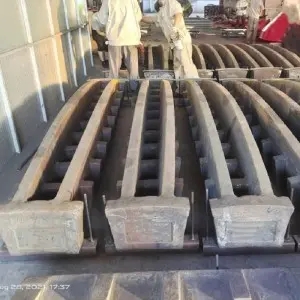
The grate is the most underrated item in the package. It sets the product size, and it sets the throughput, and it is usually specified last. A grate whose open area is too small will throttle a shredder that is otherwise capable of far more tonnage, and the symptom looks like a wear problem when it is a sizing problem.
The buyer should specify open area as a percentage, aperture size against the required product specification, and the material grade for the expected feed. Then, critically, the grate should be inspected at the same interval as the hammers, because a grate that has worn open is silently shipping oversize product that the downstream separation step will reject.
A shredder grate for metal crusher parts should therefore be ordered with a measured aperture drawing and a stated acceptance tolerance, since the aperture is the product specification rather than a manufacturing detail.
Reject Doors and Caps: The Parts Nobody Orders Until They Fail
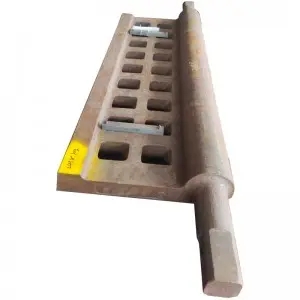
The reject door exists to eject material that will not pass, and it is the part that absorbs the worst impacts in the machine. Because it fails intermittently rather than on a visible wear curve, it is almost never stocked, and it is therefore the part most likely to stop the line for a week while a replacement is made.
The fix is inventory discipline rather than metallurgy. Buyers should hold one reject door per machine as a strategic spare, because the lead time on a heavy casting is far longer than the tolerance for downtime on a shredder line.
A shredder reject door should be ordered with its hinge and actuation interface dimensioned against the existing machine, because a door that fits the opening but not the mechanism is worse than no spare at all.
Caps and end protection components are in the same category: low unit cost, high consequence, and almost never stocked. Holding a set of shredder caps and protective components alongside the reject door is the smallest insurance policy available in the wear parts budget.
Building the Order as a Package
The most useful change a buyer can make is to stop ordering four separate items and start ordering one wear set per campaign. Define the campaign in tonnes or hours, then specify hammer sets, grate sets, reject door spares and caps against that campaign, with a documented expected life per item.
That structure does two things. It makes the true cost per tonne visible for the first time, because the four items stop being four separate budget lines. And it gives the supplier something to be accountable for: a set life per campaign, against a stated feed, is a commitment, whereas a hammer price is not.
The buyer should also insist on a feed description in the order. Shredder wear life is meaningless without knowing what is going into the machine, and a supplier quoting without that information is quoting a guess.
The Takeaway
Specify shredder wear parts on toughness rather than hardness, order hammers as weight-matched sets with a rotation schedule, size the grate on open area rather than by habit, and hold a reject door as a strategic spare. Do that and the shredder stops being a machine that consumes parts and becomes a line with a known cost per tonne, which is the only number the operation actually sells on.
Related Pages
Jaw Plate Pricing Guide: Cost Analysis by Material Grade
Mantle vs Bowl Liner: Key Differences Every Aggregate Buyer Must Know
OEM vs Aftermarket Crusher Wear Parts
Post time: Oct-15-2026